Adulterant testing checklist: ensure reliable drug screening

TL;DR:
- An effective adulterant testing checklist documents every procedural safeguard with results, initials, and timestamps.
- Combining point-of-care strips with lab testing enhances detection of common and complex adulterants.
- Maintaining updated protocols, staff training, and documentation are essential for compliance and audit success.
Failing a regulatory audit because a specimen slipped through with compromised integrity is not a theoretical risk. It happens at clinics, staffing agencies, and government-contracted programs every year, and the downstream consequences range from voided test results to program decertification. A rigorous adulterant testing checklist is the single most effective structural defense against those outcomes. This guide breaks down exactly what that checklist must contain, which tools belong in your protocol, and how to match your approach to your compliance obligations, whether you run a small occupational health clinic or a federally mandated workplace drug screening program.
Table of Contents
- Key criteria for a compliant adulterant testing checklist
- Essential adulterant tests and tools you need
- Specimen collection best practices for tamper prevention
- Comparison table: Field strips vs. lab testing
- Making the right choice for your clinic or program
- Expert perspective: What most clinics miss about adulterant testing
- Find compliant drug test kits and supplies
- Frequently asked questions
Key Takeaways
| Point | Details |
|---|---|
| Test all five parameters | Comprehensive validity checks are vital for compliance and defensibility. |
| Use both field and lab methods | Combine point-of-care strips with lab analysis to cover all tampering risks. |
| Follow collection best practices | Strict collection protocols prevent most specimen adulteration attempts. |
| Update checklists regularly | Revise protocols to address new adulterants and regulatory guidance. |
Key criteria for a compliant adulterant testing checklist
With the need for credibility established, let’s break down what an effective adulterant testing checklist must include.
A compliant adulterant testing checklist is not a generic form. It is a structured protocol that documents every procedural and technical safeguard applied to each specimen. Federal and non-federal programs alike benefit from treating the checklist as a legal document, because during an audit or a legal challenge, it functions as exactly that.SAMHSA mandates that certified laboratories test all five validity parameters on every federal workplace specimen. Non-federal programs often adopt the same standard voluntarily, because it provides the same defensibility in civil or employment disputes. Your checklist should reflect all five parameters explicitly.
The five mandatory validity parameters are:
- Temperature: Verified at collection, between 90°F and 100°F within four minutes
- pH: Acceptable range is 4.5 to 8.5; values outside indicate adulteration or substitution
- Creatinine: Below 2 mg/dL combined with specific gravity below 1.001 indicates substitution
- Specific gravity: Must fall between 1.003 and 1.030 for a valid specimen
- Oxidants: Including nitrites, bleach, and glutaraldehyde, which are common masking agents
Every item on this list needs a corresponding line on your checklist with the result, the technician’s initials, and a timestamp. This structure supports both internal audits and third-party reviews.
“A checklist without documentation fields is just a reminder. For compliance purposes, it becomes evidence only when results, names, and timestamps are consistently recorded for every specimen.”
If any parameter falls outside acceptable ranges, the checklist must trigger a specific response. For most programs, an invalid specimen requires direct observation recollection. That protocol needs to be spelled out clearly, not left to individual technician judgment. Clear, written decision trees reduce legal exposure and prevent inconsistent handling. Reviewing adulterant checklist tips before finalizing your template helps identify gaps that compliance reviewers commonly flag.
Pro Tip: Build your checklist in a format that requires a signature for every decision point, not just the final result. That single change closes the most common documentation gap found during accreditation audits.
For staffing agencies managing multi-site testing programs, compliance steps for staffing organizations provide a useful framework for standardizing these forms across locations.
Essential adulterant tests and tools you need
Once you understand the required criteria, next comes selecting the right adulterant test tools for your setting.
The market for adulterant detection tools ranges from inexpensive dip strips to sophisticated mass spectrometry platforms. The right combination depends on your volume, budget, setting, and the regulatory framework governing your program. Most organizations benefit from layering both point-of-care and confirmatory tools.
Here is a practical breakdown of the primary tools and where each belongs in your workflow:
- Oxidant test strips: Detect common adulterants including nitrites, bleach, pyridinium chlorochromate, and glutaraldehyde. Fast, low-cost, and effective for the most frequently used masking agents. Suitable for clinic and occupational health settings.
- Temperature strips: Built into most collection cups or applied at collection. Provide an immediate first-line check before the specimen moves further into the process.
- Multi-parameter adulterant strips: Single-dip strips that check pH, creatinine, nitrites, specific gravity, oxidants, and sometimes glutaraldehyde simultaneously. Reduce technician steps and minimize handling variability.
- Integrated drug test cups with adulterant panels: The most efficient format for high-volume settings. A single cup captures the specimen, runs the drug screen, and validates five or more parameters in one step.
- Confirmatory GC/MS or LC/MS/MS testing: Required for any specimen that will be used in legal proceedings, federal programs, or where MRO review is mandated. Gas chromatography/mass spectrometry and liquid chromatography/mass spectrometry protocols provide irrefutable identification of both drugs and adulterants.
- Proteomics and advanced mass spectrometry: Reserved for forensic or high-stakes cases. Strips detect common agents quickly and affordably, but they miss novel or chemically degraded adulterants. Mass spectrometry-based proteomics is required when sophisticated tampering is suspected.
Understanding the full spectrum of adulterants in drug testing helps procurement teams make informed decisions about which strips to stock and when to escalate to confirmatory methods.
Pro Tip: For high-volume collection sites, integrated cups with built-in adulterant panels cost more per unit than standalone strips but reduce total handling time by 30 to 40 percent compared to running the drug screen and validity tests separately. Calculate total labor cost, not just supply cost, when comparing formats.
Bundling tools strategically also reduces the risk of technician error. When validity checks are built into the same device as the drug screen, there is no opportunity to skip them accidentally. That design feature alone closes one of the most common gaps identified in program audits. For a deeper look at maintaining accuracy across your whole screening process, see tips for reliable drug results.
Specimen collection best practices for tamper prevention
After ensuring your technology is robust, you must also eliminate weak links in collection and handling procedures.
Even the best testing technology cannot compensate for a compromised collection environment. Specimen tampering most often happens during the collection window, before the sample is sealed. Structural controls during this phase are non-negotiable.SAMHSA-aligned collection best practices include a clear set of environmental and procedural requirements. Your checklist should verify all of the following before every collection session:
- Same-sex observer or open-door policy when direct observation is required; document the observer’s name and relationship to the collection process
- No access to water sources: Secure or tape off sinks, turn off water supply, and remove any accessible water containers from the collection area
- Bluing agent in toilet water: Use blue dye tablets in toilet tanks to prevent donors from using toilet water to dilute specimens
- Temperature verification within four minutes: Use a temperature strip affixed to the collection container or a separate thermometer; record the reading on the chain of custody form
- Creatinine and specific gravity cross-check: Both values must be evaluated together; either alone can produce misleading results in borderline cases
- Tamper-evident sealing: Apply tamper-evident tape over the specimen cap immediately after collection and have the donor initial the tape
- Refrigeration until lab arrival: Specimens held longer than one hour before transport should be refrigerated at 2°C to 8°C to prevent degradation of creatinine and other validity markers
Statistical note: Studies of federally monitored collection sites show that environmental controls, specifically bluing agents and restricted sink access, reduce substitution attempts by a meaningful margin compared to sites relying solely on observation.
These steps are not suggestions. For programs operating under federal contractor requirements, they are procedural mandates. For everyone else, they represent the standard of care that courts use to evaluate program integrity. Following the seven-step program for clinics gives your team a structured rollout framework for implementing these controls site by site.
Comparison table: Field strips vs. lab testing
To aid decision making, here is a head-to-head look at field-ready strips versus laboratory testing protocols.
| Feature | Point-of-care strips | Laboratory (GC/MS or LC/MS/MS) |
|---|---|---|
| Cost per test | Low ($1 to $5 per panel) | High ($30 to $100+ per specimen) |
| Result turnaround | 2 to 5 minutes | 24 to 72 hours |
| Adulterants detected | Common: nitrites, bleach, oxidants, glutaraldehyde | Broad: novel synthetics, degraded compounds, proteomics |
| Legal defensibility | Strong for non-federal | Required for federal and legal proceedings |
| MRO review required | No | Yes (federal programs) |
| Suitable for | Clinics, staffing agencies, treatment centers | Federal workplaces, DOT programs, legal cases |
| Chain of custody | Site-managed | Lab-managed with dual custody |
Point-of-care strips are sufficient and legally defensible for most clinic and staffing use cases, but federal programs and government agencies require laboratory specimen validity testing plus Medical Review Officer (MRO) review without exception.
Importance of Drug Screening
Choosing the right approach depends on three factors:
- Compliance jurisdiction: Are you operating under DOT, SAMHSA federal mandates, or internal non-federal policy?
- Risk level: How severe are the consequences of a false negative or successfully adulterated specimen in your specific context?
- Volume and turnaround needs: High-volume pre-employment screening for a staffing agency has different priorities than a treatment center monitoring patients weekly
Reviewing adulterant checklist tips alongside the government compliance overview helps administrators map the right tools to their specific regulatory environment before procurement decisions are finalized.
Making the right choice for your clinic or program
Bringing the options together, here is how to craft or update your own checklist for reliable, compliant practices.
Building or updating an adulterant testing checklist requires working through four sequential decisions. Skipping any one of them typically creates the compliance gaps that show up during audits.
- Assess your regulatory environment first. Determine whether your program falls under federal mandates, state regulations, or internal policy. Non-federal programs often voluntarily adopt federal validity standards because they provide the strongest legal defense. Confirm your classification in writing before selecting tools or writing procedures.
- Bundle field and laboratory strategies where your risk profile requires it. High-stakes programs, such as those serving safety-sensitive industries or criminal justice populations, should use point-of-care strips for efficiency and send all non-negative and borderline specimens for confirmatory lab testing.
- Schedule regular protocol updates. Adulterant chemistry evolves. New synthetic masking agents appear regularly, and strips calibrated for established compounds may not catch them. Set a formal protocol review cycle, at minimum annually, and incorporate updates from SAMHSA guidance and peer-reviewed literature.
- Document everything and audit regularly. Every step of your program, from collection environment checks to final result reporting, should be documented and subject to periodic internal audit. A program that is well-documented but rarely audited will still fail inspection.
| Decision point | Recommended action | Review frequency |
|---|---|---|
| Regulatory classification | Confirm in writing with legal counsel | At program launch and after any regulatory change |
| Tool selection | Match to risk level and jurisdiction | Annually or when new adulterants emerge |
| Staff training | Verify competency on all procedures | At hire and annually |
| Documentation audit | Review sample of chain of custody records | Quarterly |
See the government guideline reference for a current overview of federal standards applicable to different program types.
Expert perspective: What most clinics miss about adulterant testing
Here is where programs consistently leave themselves exposed, and it is rarely the test strips.
Most administrators invest significant effort in selecting the right testing products. That is the right instinct, but it leads to a blind spot. The technical layer of adulterant testing, the strips, the cups, the temperature checks, receives attention and budget. The operational and documentation layer does not. That imbalance is where most audit failures originate.
We see it repeatedly. A clinic has excellent products in place but cannot produce consistent chain-of-custody records. A staffing agency uses integrated adulterant panels correctly but has never run a mock audit of its own procedures. A treatment center updates its test cups when a new panel becomes available but has not updated its staff training since the products changed. Each of these situations looks fine on paper until it does not.
The second overlooked area is staff competency drift. Collection technicians learn procedures correctly at hire, but without regular refresher training, small shortcuts accumulate. Someone stops noting the temperature reading on low-volume days. An observer is not documented because the process feels routine. These gaps are invisible until an external reviewer asks to see documentation for a specific date.
Emerging synthetic adulterants are also genuinely changing the risk landscape. Products designed to fool oxidant strips are commercially available online. Your strip-based validity checks may pass specimens that are actively adulterated with agents your current tools cannot detect. The answer is not necessarily to move entirely to laboratory testing; the operational and financial case for point-of-care tools remains strong. But it does mean that regulatory compliance realities require programs to stay current with what is actually circulating, not just what strips were designed to detect five years ago.
The most defensible programs we work with share one characteristic: they treat compliance as a continuous process, not a product selection event. The checklist is updated. The staff is retrained. The documentation is audited. The tools are reviewed against current threat intelligence. That cycle, not any individual product, is what holds up under scrutiny.
Find compliant drug test kits and supplies
Updating your adulterant testing checklist is only as effective as the products behind it. If your current supplies are outdated, inconsistently formatted, or not matched to your compliance requirements, the checklist itself becomes a liability.
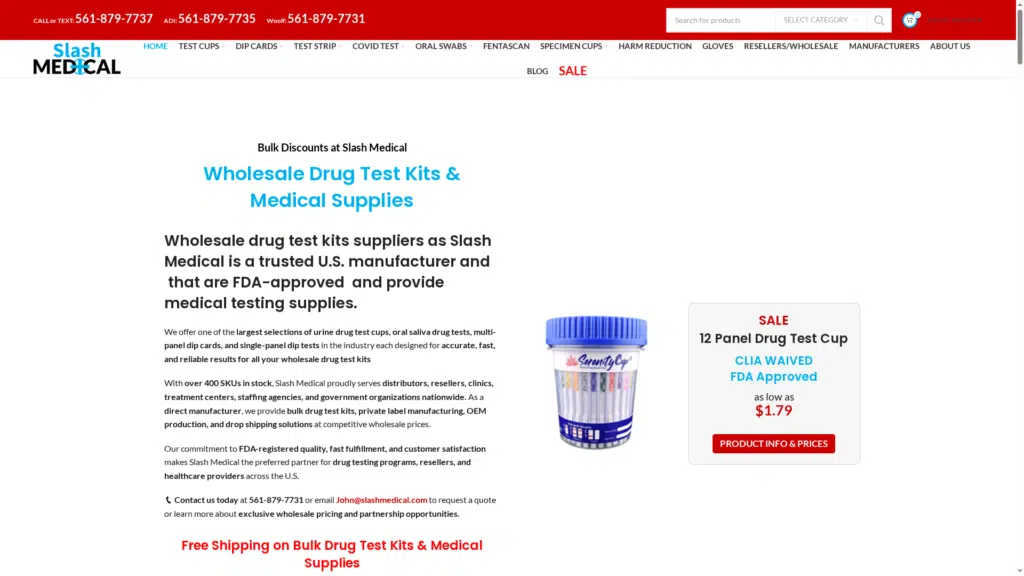
Slash Medical offers a complete catalog of drug testing strips and integrated adulterant testing devices designed specifically for clinical, staffing, and government program requirements. All products are FDA-approved and CLIA waived, with options ranging from individual dip panels to fully integrated drug test cups with built-in validity parameters. For programs purchasing at volume, wholesale dip strips are available with bulk pricing, private label manufacturing, and drop-shipping solutions that streamline procurement across multiple locations. Contact us to discuss program-specific requirements and volume pricing.
Frequently asked questions
What are the five validity parameters in adulterant testing?
Temperature, pH, creatinine, specific gravity, and oxidant checks are the five SAMHSA-mandated validity parameters required for federal workplace drug testing specimens.
When should a specimen be recollected under direct observation?
A specimen must be recollected under direct observation if it is declared invalid for any reason, including out-of-range validity parameters or an unsuitable sample volume.
Are point-of-care strips enough for government drug testing compliance?
No. Government and federal programs require full laboratory validity testing plus MRO review; point-of-care strips serve as rapid screening tools only and do not satisfy federal chain-of-custody requirements.
Why do programs use both strips and lab methods?
Combining strips and lab methods detects both common and sophisticated adulterants, because strips miss some agents that proteomics and confirmatory mass spectrometry reliably identify, giving programs maximal detection coverage across all risk levels.