
Rapid Antigen Testing: Speed, Accuracy, and Impact

Finding reliable rapid antigen testing supplies while keeping costs low is an urgent challenge for procurement managers in clinics and treatment centers across North America, Europe, Asia, and beyond. Rapid antigen tests offer fast results—often in under 30 minutes—without the need for complex laboratory equipment or highly trained staff. This article breaks down how these tests work, outlines key features, and highlights what to look for when sourcing affordable and effective COVID-19 diagnostic tools.
Table of Contents
- What Rapid Antigen Testing Involves
- Common Types And Key Use Cases
- How Rapid Antigen Tests Work
- Regulatory Standards And Market Entry Requirements
- Benefits, Drawbacks, And Performance Limitations
- Cost, Procurement, And Manufacturer Selection
Key Takeaways
| Point | Details |
|---|---|
| Rapid Antigen Testing Advantages | Provides quick results, typically within 30 minutes, at a lower cost compared to molecular tests. |
| Testing Formats and Use Cases | Includes lateral flow immunoassays and at-home testing kits, with applications in population screening and healthcare settings. |
| Performance Limitations | While rapid, these tests have reduced sensitivity and may not reliably detect infections in asymptomatic individuals. |
| Regulatory Compliance | Manufacturers must meet strict performance standards and ensure all tests are CE marked for European markets. |
What Rapid Antigen Testing Involves
Rapid antigen testing represents a fast and accessible diagnostic approach for detecting specific viral proteins directly from patient samples. Antigen detection methods provide results within minutes, making them crucial for quick medical decision-making.
These diagnostic tests work by identifying viral proteins through lateral flow immunoassay technology, which allows for swift and cost-effective screening. The process involves collecting biological samples like nasal swabs or saliva and applying them to specialized test devices that can detect viral antigens.
Key characteristics of rapid antigen testing include:
- Speed of results (typically under 30 minutes)
- Lower cost compared to molecular testing
- Portability and ease of use
- Minimal technical expertise required
- Potential for point-of-care and home testing
Rapid antigen tests have proven particularly valuable during infectious disease outbreaks, enabling quick identification and isolation of potential cases. Their applications extend beyond clinical settings, with potential uses in food safety, forensics, and veterinary testing.
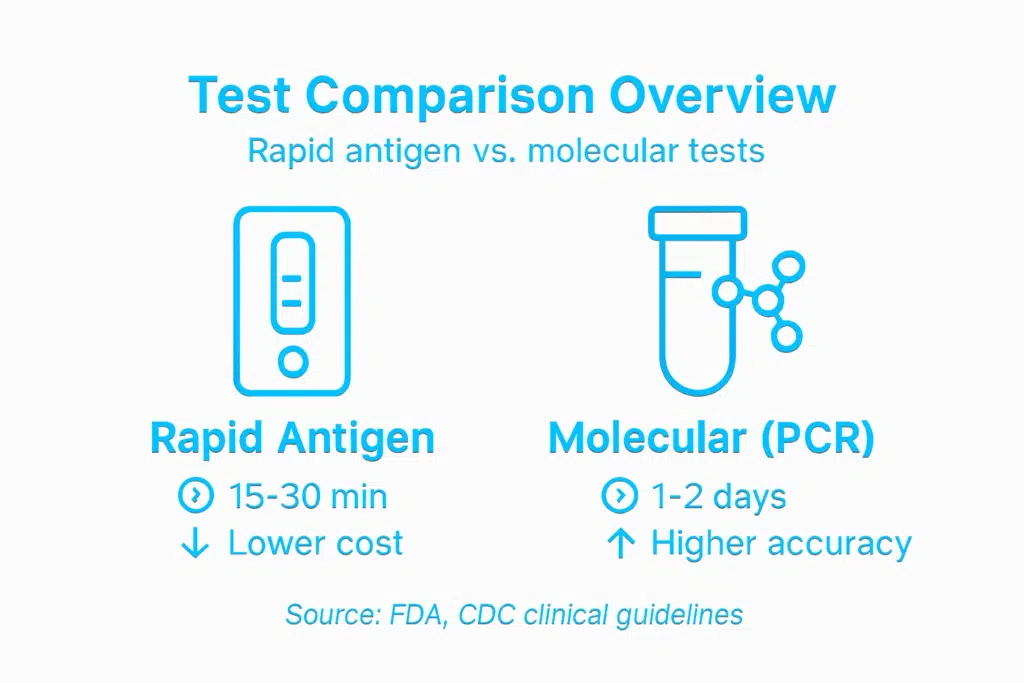
Here’s a summarized comparison of rapid antigen tests and molecular tests:
| Aspect | Rapid Antigen Tests | Molecular Tests (e.g., PCR) |
|---|---|---|
| Result Time | Under 30 minutes | Several hours to days |
| Cost | Low | High |
| Sensitivity | Moderate | Very high |
| Required Expertise | Minimal | Specialized laboratory staff |
| Use Cases | Point-of-care, home, screening | Confirmatory diagnosis, epidemiology |
Pro tip: Always follow manufacturer instructions precisely and understand that rapid antigen tests have limitations in sensitivity compared to molecular tests.
Common Types and Key Use Cases
Rapid antigen diagnostic tests come in several distinct formats, with lateral flow immunoassays representing the most prevalent technology for quick viral protein detection. These tests are designed to provide fast, accessible screening across multiple healthcare and public health scenarios.
The primary categories of rapid antigen tests include:
- Lateral Flow Immunoassays: Single-use devices producing results within 15-30 minutes
- Multiplex Sandwich Chemiluminescent Enzyme Immunoassays: More complex tests enabling multiple pathogen detection
- Point-of-Care Tests: Designed for immediate clinical settings
- At-Home Testing Kits: Consumer-friendly options for personal screening
Antigen-detecting rapid diagnostic tests serve six primary use case categories:
- Mass Population Screening
- Targeted Screening
- Healthcare Entry Testing
- At-Home Testing
- Surveillance Programs
- Prevalence Surveys
While these tests offer remarkable speed and convenience, they typically demonstrate lower sensitivity compared to molecular testing methods. Their primary advantage lies in rapid identification of potentially infectious individuals, enabling swift public health interventions.
Rapid antigen tests excel in scenarios requiring immediate results, particularly in high-transmission risk environments like schools, workplaces, and healthcare facilities.
Pro tip: Always validate rapid antigen test results with confirmatory molecular testing, especially in high-stakes medical scenarios.
How Rapid Antigen Tests Work
Rapid antigen tests utilize lateral flow immunoassay technology to detect specific viral proteins quickly and efficiently. This innovative diagnostic approach enables medical professionals and individuals to identify potential infections within minutes, providing a critical tool for disease management and prevention.
The testing process involves several precise steps:
- Sample Collection: Obtaining biological material via nasal or throat swab
- Sample Preparation: Mixing the sample with a specialized buffer solution
- Antigen Extraction: Releasing viral proteins from the collected sample
- Antibody Interaction: Applying the prepared sample to a test strip
- Result Visualization: Observing color changes indicating viral presence
Rapid antigen testing mechanisms operate through a sophisticated molecular detection process. When viral antigens are present, they bind with specially designed antibodies conjugated with dye particles, creating visible lines on the test strip that indicate a positive result.
The sensitivity of rapid antigen tests varies, typically providing accurate results during the most infectious stages of a disease.
The entire testing procedure occurs within 15 to 30 minutes, making these diagnostic tools invaluable for point-of-care and self-testing scenarios. While less precise than molecular testing methods, rapid antigen tests offer unparalleled speed and accessibility.

Pro tip: Always follow the manufacturer’s instructions precisely and interpret test results in conjunction with clinical symptoms and professional medical advice.
Regulatory Standards and Market Entry Requirements
Manufacturers seeking to introduce rapid antigen tests must navigate complex regulatory compliance frameworks that ensure product safety and performance. These stringent requirements protect public health by establishing rigorous standards for diagnostic medical devices.
Key regulatory requirements for market entry include:
- Technical Documentation: Comprehensive evidence demonstrating device safety and intended performance
- Performance Thresholds: Minimum sensitivity and specificity standards
- CE Marking: Official certification for European market distribution
- Intended Use Declaration: Precise specification of test application
- Post-Market Surveillance: Ongoing monitoring of test performance
The European Commission’s testing recommendations establish critical performance benchmarks for rapid antigen tests:
- Minimum sensitivity requirement: 80%
- Minimum specificity requirement: 97%
- Comprehensive technical file submission
- Compliance with medical device regulations
Manufacturers must provide extensive scientific evidence demonstrating their test’s reliability and accuracy across diverse testing scenarios.
Regulatory compliance involves multiple stakeholders, with Member States ultimately responsible for implementing specific testing strategies and ensuring test suitability for their populations.
The following table provides a quick reference for regulatory benchmarks and considerations for market entry:
| Requirement | Importance | Typical Standard |
|---|---|---|
| Sensitivity Threshold | Ensures accurate positives | ≥80% (EU recommendation) |
| Specificity Threshold | Reduces false positives | ≥97% (EU recommendation) |
| Technical Documentation | Demonstrates effectiveness | Comprehensive file |
| CE Marking | Legal market access | Mandatory in Europe |
| Post-Market Surveillance | Monitors ongoing quality | Continuous assessment |
Pro tip: Consult regulatory experts and conduct thorough performance studies before attempting to bring a rapid antigen test to market.
Benefits, Drawbacks, and Performance Limitations
Rapid antigen tests offer a nuanced diagnostic approach with significant performance considerations that healthcare professionals must carefully evaluate. These tests provide quick and affordable screening, but come with inherent limitations that require strategic implementation.
Key advantages of rapid antigen testing include:
- Rapid Results: Diagnosis within 15-30 minutes
- Low Cost: More affordable than molecular testing
- Ease of Use: No specialized laboratory equipment required
- Point-of-Care Applicability: Can be performed in various settings
- High Specificity: Low rates of false-positive results
Performance limitations present critical challenges for diagnostic accuracy:
- Reduced sensitivity in asymptomatic individuals
- Variable accuracy across different test brands
- Lower performance with low viral loads
- Potential for false-negative results
- Limited effectiveness in detecting new viral variants
Rapid antigen tests are most effective when performed early in the infection cycle and interpreted with clinical context.
The diagnostic utility of these tests depends on understanding their strengths and weaknesses, requiring healthcare providers to integrate multiple testing strategies for comprehensive disease management.
Pro tip: Combine rapid antigen testing with molecular confirmation and clinical assessment for the most reliable diagnostic approach.
Cost, Procurement, and Manufacturer Selection
Navigating the complex landscape of rapid antigen test procurement requires a strategic approach that balances cost-effectiveness with performance requirements. Organizations must carefully evaluate multiple factors to optimize their testing strategies and resource allocation.
Key considerations for manufacturer selection include:
- Regulatory Compliance: CE marking and approved test lists
- Performance Metrics: Minimum accuracy standards (≥95%)
- Supply Reliability: Consistent production capabilities
- Cost Competitiveness: Balanced pricing structures
- Technical Documentation: Comprehensive effectiveness proof
Public procurement processes typically evaluate manufacturers across multiple critical dimensions:
- Validated clinical performance data
- Regulatory approvals
- Production scalability
- Price point analysis
- Quality control mechanisms
Successful procurement strategies prioritize comprehensive evaluation over singular cost considerations.
The total cost of rapid antigen testing extends beyond immediate purchase price, encompassing implementation complexity, operational efficiency, and potential public health outcomes.
Pro tip: Develop a comprehensive evaluation matrix that weights performance, reliability, and cost to make informed manufacturer selection decisions.
Optimize Your Rapid Testing Strategy with Trusted Medical Supplies
Rapid antigen testing offers fast and accessible diagnostics but requires reliable, high-quality testing supplies to ensure accuracy and efficiency. Whether you manage a clinic, a healthcare facility, or a workplace screening program, consistent access to FDA-approved and CLIA-waived products is essential to overcoming challenges like varying test sensitivity and regulatory demands. Slash Medical specializes in delivering over 400 trusted testing solutions including drug and COVID-19 tests designed for bulk ordering, private labeling, and seamless nationwide shipping.
Explore how Slash Medical can support your rapid antigen and drug testing needs with competitive wholesale pricing and comprehensive product options. Don’t settle for less when your testing programs demand precision and speed. Visit Slash Medical now to browse our catalog, inquire about OEM services, and secure supplies that empower your next testing initiative with confidence.
Frequently Asked Questions
What is rapid antigen testing?
Rapid antigen testing is a fast diagnostic method that detects specific viral proteins from patient samples, providing results within minutes and enabling quick medical decision-making.
How do rapid antigen tests work?
Rapid antigen tests utilize lateral flow immunoassay technology to detect viral proteins. After collecting a biological sample, the sample is mixed with a buffer solution, allowing viral proteins to bind with antibodies on a test strip, which then indicates the presence of the virus through visible lines.
What are the benefits of using rapid antigen tests?
Rapid antigen tests offer quick results (within 15-30 minutes), lower costs compared to molecular tests, ease of use, and potential for point-of-care applications, making them valuable for rapid screening in various settings.
What are the limitations of rapid antigen testing?
Rapid antigen tests generally have lower sensitivity than molecular tests, particularly in asymptomatic individuals and during early infection stages. They may result in false-negative outcomes and vary in accuracy depending on the brand and viral load.