
What Is DOT Drug Testing and Why It Matters
Most American clinics and treatment centers know a single missed DOT drug test can put both their reputation and federal contracts at risk. For operations managers, staying compliant with Department of Transportation requirements impacts more than daily workflow—it is about protecting public safety and avoiding serious penalties. This article brings clarity to what is DOT drug testing rules, essential screening protocols, and proven compliance strategies every clinic should master.
Table of Contents
- Defining DOT Drug Testing and Key Concepts
- DOT-Approved Substances and Test Types
- Federal Regulations and Employer Obligations
- DOT Drug Testing Procedures and Protocols
- Compliance Challenges and Avoiding Common Pitfalls
Key Takeaways
| Point | Details |
|---|---|
| Importance of DOT Drug Testing | DOT drug testing is vital for maintaining workplace safety in transportation sectors, ensuring that safety-sensitive employees are substance-free. |
| Testing Requirements | Employers must follow strict guidelines under 49 CFR Part 40, encompassing various testing stages like pre-employment and random intervals. |
| Substance Categories | The testing focuses on five main substances: Marijuana, Cocaine, Amphetamines, Opioids, and Phencyclidine, all assessed through rigorous lab testing. |
| Compliance Obligations | Employers are responsible for implementing training programs and maintaining accurate documentation to meet DOT regulations and avoid penalties. |
Defining DOT Drug Testing and Key Concepts
DOT drug testing represents a critical federal safety protocol designed to maintain workplace safety in transportation sectors. Federally mandated testing procedures ensure that commercial drivers and safety-sensitive employees remain substance-free while performing critical job functions. This comprehensive testing regime targets commercial motor vehicle operators, aviation personnel, railroad workers, and other transportation professionals who directly impact public safety.
The Department of Transportation establishes specific guidelines under 49 CFR Part 40 that comprehensively define testing requirements. Safety-sensitive employees are required to undergo drug screening at multiple employment stages including pre-employment, random intervals, post-accident situations, reasonable suspicion scenarios, return-to-duty assessments, and mandatory follow-up evaluations. These regulated testing stages help prevent substance-related impairment that could compromise transportation safety.
Under DOT regulations, drug tests screen for five primary substance categories: marijuana, cocaine, amphetamines, opioids, and phencyclidine (PCP). Employers must conduct these tests through certified laboratories using strict chain-of-custody protocols to ensure accurate and legally defensible results. The comprehensive screening process includes initial immunoassay testing followed by definitive gas chromatography mass spectrometry confirmation for any non-negative initial results.
Pro Tip: Implement a robust internal tracking system that monitors employee drug testing compliance and maintains meticulous documentation to streamline DOT regulatory requirements.
DOT-Approved Substances and Test Types
DOT regulations mandate a standardized approach to drug screening that focuses on five primary substance categories. Federal testing guidelines specify comprehensive screening protocols for commercial transportation workers, ensuring workplace safety through rigorous substance detection methods. The standard 5-panel drug test represents the cornerstone of DOT substance screening, targeting substances that could significantly impair job performance and public safety.
The five DOT-approved substance categories include marijuana metabolites (THC), cocaine metabolites, amphetamines, opioids, and phencyclidine (PCP). Amphetamine screening encompasses multiple compounds including methamphetamine and MDMA, while opioid testing covers substances like heroin, hydrocodone, oxycodone, and morphine. Each substance category is meticulously analyzed using advanced laboratory techniques that provide scientifically validated and legally defensible results.
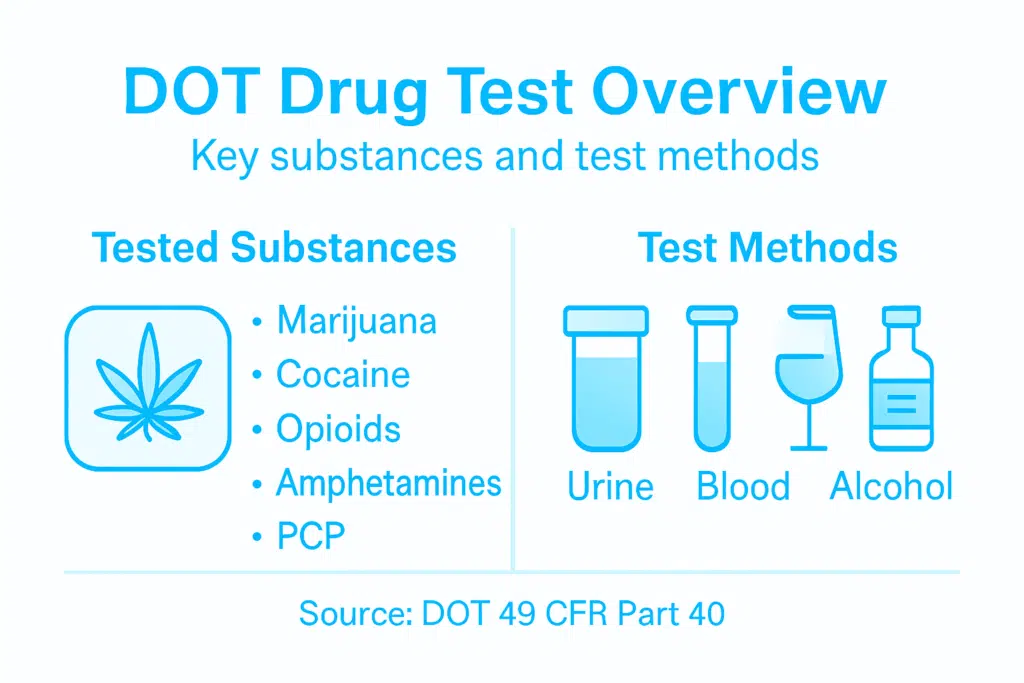
Beyond the standard 5-panel test, DOT regulations also mandate alcohol screening with specific concentration thresholds. Alcohol tests identify concentration levels of 0.02 and greater, providing an additional layer of safety assessment for transportation professionals. Regulated testing protocols require multiple testing scenarios including pre-employment screening, random intervals, post-accident investigations, reasonable suspicion evaluations, return-to-duty assessments, and mandatory follow-up testing to maintain continuous workplace safety standards.
Here’s a summary of the five DOT-approved substance categories and their typical workplace impact:
| Substance Category | Common Examples | Workplace Risk | Detection Method |
|---|---|---|---|
| Marijuana (THC) | Cannabis, edibles | Impaired judgment, slower reaction time | Immunoassay followed by GC/MS |
| Cocaine | Powder, crack | Hyperactivity, poor decision-making | Immunoassay followed by GC/MS |
| Amphetamines | Methamphetamine, MDMA | Risky behavior, over-alertness | Immunoassay followed by GC/MS |
| Opioids | Heroin, oxycodone, morphine | Drowsiness, decreased alertness | Immunoassay followed by GC/MS |
| Phencyclidine (PCP) | Angel dust | Aggressive behavior, hallucinations | Immunoassay followed by GC/MS |
Pro Tip: Develop a comprehensive internal tracking system that documents all drug testing results, ensuring full compliance with DOT regulatory requirements and maintaining meticulous record-keeping practices.
Federal Regulations and Employer Obligations
DOT drug testing regulations impose comprehensive compliance requirements on employers in transportation sectors. Regulatory compliance framework mandates strict guidelines that employers must implement to maintain workplace safety and meet federal standards. Commercial driver’s license (CDL) holders and safety-sensitive employees are subject to rigorous testing protocols that place significant responsibility on employers to develop and maintain robust drug testing programs.

The 49 CFR Part 40 establishes the primary regulatory structure governing drug and alcohol testing procedures. Employers are required to implement multiple critical components, including: establishing clear testing protocols, maintaining accurate recordkeeping, ensuring proper chain of custody for test specimens, protecting employee privacy, and managing interactions with certified testing service agents. Detailed testing requirements outline specific obligations that employers must fulfill, including comprehensive documentation and reporting standards that leave no room for procedural ambiguity.
Employer obligations extend beyond simple test administration. Organizations must develop comprehensive training programs, implement systematic screening processes, and maintain meticulous records of all drug testing activities. This includes managing pre-employment screenings, random testing intervals, post-accident investigations, reasonable suspicion evaluations, return-to-duty assessments, and mandatory follow-up testing. Employers bear ultimate legal and financial responsibility for ensuring full compliance with DOT regulations, with potential significant penalties for procedural failures or overlooked testing requirements.
Pro Tip: Create a centralized compliance management system that tracks all drug testing documentation, training records, and regulatory updates to ensure comprehensive DOT regulation adherence.
DOT Drug Testing Procedures and Protocols
The DOT drug testing process follows a meticulously structured approach designed to ensure accuracy, fairness, and comprehensive screening. Standardized collection procedures begin with rigorous employee identification verification and controlled specimen collection methods that prevent potential tampering. Certified collection sites implement strict protocols to maintain the integrity of the testing process, including detailed documentation and chain of custody requirements.
Split specimen testing provides an additional layer of fairness and accuracy in DOT drug screenings. When an initial test returns a non-negative result, employees have the right to request a confirmatory test using the second, separately stored specimen. Laboratory testing protocols involve two-stage testing processes: an initial immunoassay screening followed by a more precise gas chromatography mass spectrometry (GC/MS) confirmation test. Medical Review Officers (MROs) carefully evaluate all test results, providing a critical review process that protects both employee rights and workplace safety.
The comprehensive DOT testing procedure encompasses multiple testing scenarios, including pre-employment screening, random intervals, post-accident investigations, reasonable suspicion evaluations, return-to-duty assessments, and mandatory follow-up testing. Each scenario follows specific guidelines for specimen collection, including potential directly observed testing in certain circumstances. Employers must maintain strict confidentiality throughout the process, protecting employee privacy while ensuring workplace safety and regulatory compliance.
The table below compares DOT drug testing scenarios and their respective objectives:
| Testing Scenario | Trigger Event | Main Objective | Typical Frequency |
|---|---|---|---|
| Pre-Employment | New hire onboarding | Ensure safety before employment | Once per candidate |
| Random Testing | Unscheduled selection | Deter ongoing substance use | Several times yearly |
| Post-Accident | Workplace incident | Assess impairment after events | As needed |
| Reasonable Suspicion | Observable behaviors | Confirm suspected drug use | As needed |
| Return-to-Duty | Post-violation | Prevent relapse and ensure readiness | Varies, ongoing |
| Follow-Up | After return-to-duty | Maintain substance-free status | Specified duration |
Pro Tip: Develop a comprehensive training program that educates both managers and employees about DOT drug testing procedures, rights, and responsibilities to ensure smooth and compliant implementation.
Compliance Challenges and Avoiding Common Pitfalls
Navigating DOT drug testing compliance requires a proactive and systematic approach to avoid potentially costly regulatory violations. Common compliance pitfalls can create significant operational risks for transportation organizations, with penalties ranging from financial sanctions to suspension of operational licenses. The most frequent compliance challenges emerge from inadequate documentation, inconsistent testing protocols, and insufficient staff training.
Paperwork accuracy represents a critical compliance battleground for DOT drug testing programs. Organizations must meticulously complete Custody and Control Forms (CCF), maintain comprehensive record-keeping systems, and ensure all documentation meets federal regulatory standards. Regulatory compliance strategies highlight the importance of implementing robust tracking mechanisms that capture every aspect of the drug testing process, from collection through final reporting.
Successful DOT drug testing compliance demands a multifaceted approach that integrates comprehensive employee education, rigorous testing protocols, and continuous process improvement. Key strategies include developing thorough training programs for HR personnel, establishing relationships with certified testing laboratories, implementing consistent random testing schedules, and creating transparent communication channels for employees. Organizations must stay current with evolving regulations, particularly emerging technologies like oral fluid testing and changes in substance screening panels.
Pro Tip: Conduct quarterly internal audits of your DOT drug testing program to proactively identify and address potential compliance gaps before they become significant regulatory issues.
Ensure DOT Drug Testing Compliance with Reliable Supplies from Slash Medical
DOT drug testing requires strict adherence to federal regulations and a seamless testing process to protect workplace safety. The challenges of documentation accuracy, certified specimen collection, and consistent screening protocols can create costly pitfalls for employers. Companies need trusted partners who provide FDA-approved drug testing kits and supplies that meet DOT standards every step of the way.
Choose Slash Medical for access to over 400 wholesale testing products including urine drug test cups, oral test kits, and adulterant tests. Our specialized inventory supports all DOT testing scenarios from pre-employment to follow-up screenings. Act now to streamline your drug testing program with supplies that are CLIA waived, competitively priced, and ready for bulk order. Visit Slash Medical to browse our catalog and elevate your compliance with confidence today.
Frequently Asked Questions
What is DOT drug testing?
DOT drug testing is a federal safety protocol established by the Department of Transportation that requires substance screening for safety-sensitive employees in transportation sectors to ensure workplace safety.
What substances are tested in DOT drug screenings?
DOT drug testing screens for five primary substances: marijuana (THC), cocaine, amphetamines, opioids, and phencyclidine (PCP). Alcohol is also tested if concentrations are 0.02 or greater.
What are the different scenarios in which DOT drug testing occurs?
DOT drug testing can occur at several stages, including pre-employment, random testing, post-accident, reasonable suspicion, return-to-duty assessments, and mandatory follow-up testing.
What are the employer’s obligations regarding DOT drug testing?
Employers are required to implement strict testing protocols, maintain accurate records, ensure proper specimen collection, protect employee privacy, and manage interactions with certified testing agents to ensure compliance with DOT regulations.