
Why Use Rapid Test Strips for Bulk Drug Testing

Conflicting opinions about rapid test strips often complicate bulk purchasing decisions for treatment centers. For procurement managers aiming to maximize budget efficiency, the choice between different drug testing supplies carries high stakes. Rapid test strips stand out for their portability, speed, and cost efficiency compared to lab tests, but understanding their strengths and limitations is key. This guide clarifies how FDA-approved rapid test strips differ in accuracy, reveals practical cost-saving strategies, and outlines what truly matters for compliance and reliability.
Table of Contents
- Rapid Test Strips Explained and Debunked
- Types of Drug Test Strips Compared
- Key Features and Accuracy Standards
- Legal Compliance and FDA Approval Requirements
- Cost Savings Versus Lab Testing Alternatives
Key Takeaways
| Point | Details |
|---|---|
| Rapid Test Strips Efficiency | Rapid test strips enable quick drug screening in 5 to 30 minutes, supporting immediate clinical decisions without laboratory delays. |
| Importance of FDA Approval | Purchase only from FDA-approved and CLIA-waived manufacturers to ensure reliability and compliance with legal requirements. |
| Cost-Effectiveness | Utilizing rapid strips significantly reduces testing costs compared to lab-based methods, optimizing treatment center budgets. |
| Variety in Test Options | Choose between single-panel and multi-panel strips based on patient demographics and testing needs for efficient screening. |
Rapid Test Strips Explained and Debunked
Rapid test strips have become a cornerstone of bulk drug testing operations, but procurement managers often hear conflicting information about their reliability and effectiveness. Let’s cut through the noise. A rapid test strip is a portable immunoassay device that detects the presence of drugs or drug metabolites in a specimen within minutes, typically delivering results in 5 to 30 minutes. Unlike laboratory-based testing that requires sophisticated equipment and trained technicians, these strips work through a simple chemical reaction. When a specimen is applied to the strip, it travels along an absorbent material where it encounters antibodies specific to targeted substances. If the drug or metabolite is present above a certain threshold, a visible line appears indicating a positive result. No line means negative. The process requires minimal training, no electricity, and produces immediate preliminary results that support your treatment center’s screening workflow.
Here’s what makes rapid test strips practical for your operation: they’re affordable, which directly impacts your bulk purchasing budget, and they’re portable enough to integrate into multiple treatment areas without infrastructure changes. The accuracy of rapid drug testing methods varies by brand and substance type, which is why purchasing from FDA-approved manufacturers matters significantly. Specificity tends to run exceptionally high, meaning false positives are rare, while sensitivity depends on the substance and concentration levels. This is precisely why treatment centers typically use rapid strips as screening tools rather than confirmatory tests. A negative result generally indicates the absence of the target substance, but a positive result requires confirmation through laboratory-based GC-MS testing before making clinical decisions. This two-tiered approach protects your center legally while keeping initial screening costs manageable.
One common misconception is that all rapid test strips perform identically. They don’t. Brand quality, manufacturing standards, and FDA approval status create meaningful differences in reliability. When evaluating strips for bulk purchasing, verify that the manufacturer is FDA-registered, that the products are CLIA waived, and that the panel configurations match your testing protocols. Some treatment centers purchase multi-panel strips testing for 5, 7, 10, or 12 substances simultaneously, while others prefer single-substance strips for specific populations. Your procurement decision should align with your center’s patient demographics, state regulations, and compliance requirements. Budget considerations matter, but the cheapest option often creates hidden costs through higher confirmation rates or staff inefficiency. A moderately priced, reliable strip from a reputable manufacturer typically delivers better economics than cutting costs on a questionable product.
Pro tip: When purchasing rapid test strips in bulk, request sample testing from your distributor first to verify performance with your specific specimen types and storage conditions before committing to large orders.
Types of Drug Test Strips Compared
Drug test strips aren’t one-size-fits-all products, and understanding the differences matters significantly when you’re purchasing for a treatment center. The main variations come down to what substances they detect, how they detect them, and what level of confirmation they require. Immunoassay-based strips dominate the market because they’re fast, affordable, and reliable for initial screening. These strips use antibodies that bind to specific drugs or metabolites when present in the specimen. The most common types detect opioids, benzodiazepines, cocaine, amphetamines, methamphetamines, marijuana, and increasingly, synthetic drugs like fentanyl. Some strips target single substances while multi-panel strips test for 5, 7, 10, or even 12 drugs simultaneously. Your choice depends on which populations you’re screening and which substances are most prevalent in your patient demographics. Single-panel strips offer lower per-test costs but require more handling if you need to screen for multiple substances. Multi-panel strips reduce touchpoints and administrative overhead, making them more efficient for high-volume testing operations.
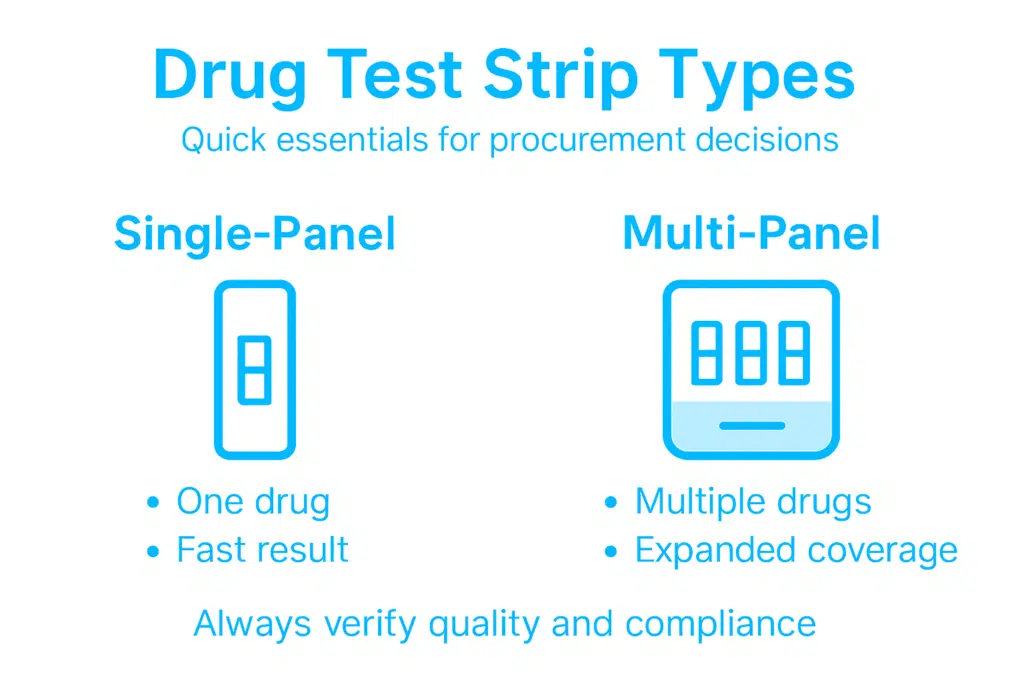
Panel configurations and detection capabilities vary substantially between products. A standard urine drug test immunoassay screens for common substances but may not include synthetic opioids or emerging drugs without specialized formulation. Detection thresholds also differ by manufacturer and product line. Some strips are calibrated to detect drugs at lower concentrations, increasing sensitivity, while others use higher thresholds that reduce false positives but might miss lower-level use. Cross-reactivity and adulterant interference are real concerns that procurement managers should discuss with distributors. Certain medications or food components can trigger false positives on some strips. This is precisely why confirmatory testing with laboratory methods like gas chromatography-mass spectrometry remains standard practice. Your two-tiered screening approach means the initial strip narrows the field quickly while the lab test provides definitive results. Understanding these limitations prevents your treatment team from acting on unreliable results.
When comparing products for bulk purchasing, create a decision matrix that evaluates substance coverage, detection thresholds, false-positive rates reported by manufacturers, panel count options, and price per test. Some treatment centers standardize on a single multi-panel strip configuration to simplify inventory and staff training, while others maintain a mix of panel types to accommodate different testing scenarios. Your storage conditions matter too. Some strips perform better in temperature-controlled environments while others maintain accuracy across wider temperature ranges. Request product specification sheets and stability data from your distributor before committing to large orders. Testing a small sample batch helps identify any issues with your specific workflows or specimen types before scaling up. The cheapest bulk price often masks problems that surface only after integration into your operations.
Here’s a comparison of single-panel versus multi-panel rapid drug test strips for procurement decisions:
| Criteria | Single-Panel Strips | Multi-Panel Strips |
|---|---|---|
| Substances tested | One per strip | 5-12 per strip |
| Per-test cost | Lowest upfront cost | Higher, but cost-effective |
| Handling requirements | More manual steps needed | Streamlined workflow |
| Efficiency for bulk use | Lower for large volumes | Ideal for high-volume sites |
| Best for | Targeted/individual cases | Broad population screening |
Pro tip: Compare not just price per test but price per confirmed result by factoring in your expected false-positive rate and confirmation testing costs, which often reveals that mid-range quality strips deliver superior total economics for your program.
Key Features and Accuracy Standards
When you’re evaluating rapid test strips for bulk purchasing, understanding the core features that drive accuracy becomes your best protection against poor purchasing decisions. The most important features center on ease of use, portability, and cost efficiency without sacrificing reliability. A quality rapid test strip requires minimal training, no specialized equipment, and produces results in minutes rather than hours. This speed allows your treatment center to make immediate clinical decisions about patient care without waiting for laboratory confirmation. The portability factor means strips can integrate into multiple treatment areas, outreach programs, or even point-of-care settings without infrastructure investment. From a procurement perspective, this translates to operational flexibility that justifies mid-range pricing over budget options that offer less practical value.
Accuracy depends heavily on two metrics that procurement managers should understand: sensitivity and specificity. Sensitivity measures how well a strip catches positive cases. A strip with 95% sensitivity will correctly identify 95 out of 100 truly positive specimens, meaning 5 false negatives slip through. Specificity measures false positive rate. A strip with 98% specificity means only 2 out of 100 negative specimens incorrectly show positive. For treatment centers, higher specificity typically matters more than sensitivity because false positives trigger unnecessary confirmatory testing and patient management complications. Validated immunoassay test strips undergo rigorous performance evaluations to establish these parameters before FDA approval. When reviewing product specifications from potential suppliers, look for published sensitivity and specificity data specific to the substances your center tests most frequently. Different strips perform differently across different drugs. A strip optimized for opioids may perform differently for benzodiazepines or synthetic cannabinoids.
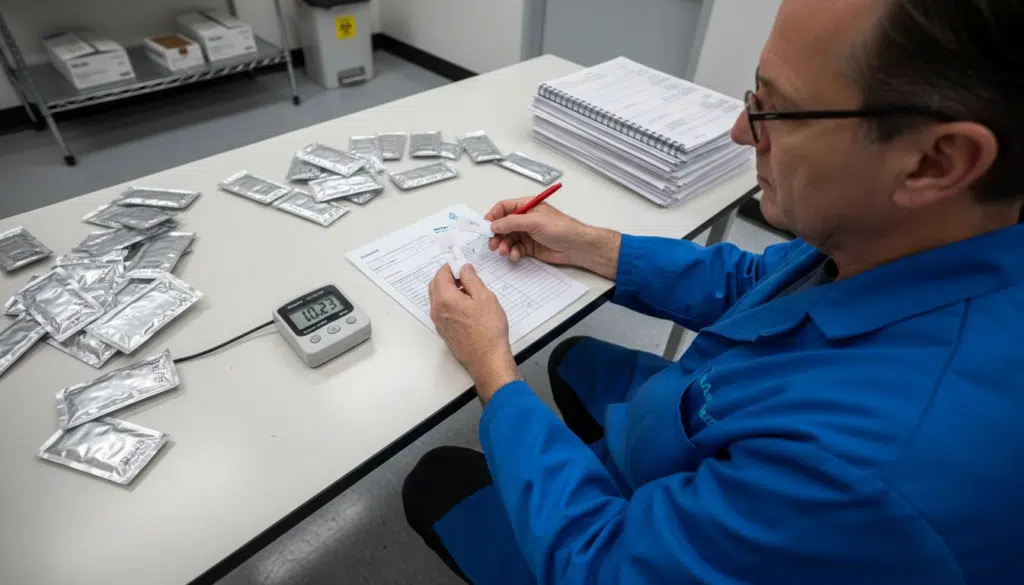
Quality control and standardization separate reliable strips from questionable products. The best manufacturers validate their reagents, maintain consistent production protocols, and include internal controls on each strip to verify proper performance. These internal controls appear as lines on the strip that confirm the test processed correctly. If the control line doesn’t appear, the result is invalid and requires retesting. FDA approval and CLIA waiver status confirm that a manufacturer meets stringent standards for manufacturing, quality assurance, and performance documentation. Accuracy standards also require adherence to quality measures that minimize false results through proper storage, handling, and operational protocols. When you’re comparing bulk suppliers, inquire about their quality certifications, shelf-life data, and temperature stability information. Strips stored improperly or past expiration dates deliver degraded accuracy. Your procurement contract should specify storage conditions and shelf-life requirements to protect your investment.
Pro tip: Request stability data showing how accuracy degrades over time and temperature ranges, then validate one test strip batch yourself under your actual storage and handling conditions before committing to a large bulk purchase.
Legal Compliance and FDA Approval Requirements
The regulatory landscape for rapid test strips in treatment centers requires attention, particularly as procurement managers navigate purchasing decisions that carry compliance implications. The FDA classifies rapid drug test strips as medical devices under the Federal Food, Drug, and Cosmetic Act, which means manufacturers must meet specific regulatory standards before marketing these products. However, the regulatory environment has shifted recently. Recent federal court rulings on FDA authority have created uncertainty about oversight of laboratory-developed tests, including rapid strips. A federal court ruled that laboratory-developed tests are medical services rather than devices, potentially placing them outside FDA’s traditional regulatory jurisdiction. This distinction matters because it affects which manufacturers must comply with FDA device regulations and which may operate under different frameworks. For treatment centers, this ambiguity underscores the importance of purchasing from manufacturers who voluntarily maintain FDA compliance standards regardless of current regulatory interpretation.
While the regulatory environment evolves, purchasing FDA-approved and CLIA-waived strips remains the safest procurement strategy for treatment centers. CLIA waived status specifically certifies that a test is simple enough to use outside laboratory settings with minimal training and quality control procedures. This classification directly enables use in treatment center environments without requiring Complex Laboratory or High Complexity certification. Medical device regulations require manufacturers to demonstrate validation, quality system compliance, and premarket safety evidence before marketing strips commercially. Manufacturers operating under these standards have undergone rigorous testing to establish sensitivity, specificity, and accuracy across diverse use scenarios. When you’re evaluating suppliers for bulk purchasing, verify that their products carry explicit FDA approval and CLIA waiver documentation. Marketing claims without supporting regulatory documentation represent red flags. Your procurement contracts should specify that suppliers maintain current regulatory compliance and possess valid approvals from the date of purchase through the entire shelf-life of the product.
State and local regulations may impose additional requirements beyond federal standards. Some states mandate specific testing protocols, panel configurations, or confirmatory procedures that affect which strips you can use. Treatment centers operating across multiple states face particularly complex compliance scenarios. Your legal and compliance team should review state board of pharmacy regulations, state department of health requirements, and any state-specific drug testing guidelines that affect your purchasing decisions. OSHA compliance considerations extend to occupational health testing environments if your center conducts workplace drug testing programs. Your procurement strategy should integrate these varied compliance requirements into supplier selection criteria. Purchasing from manufacturers who maintain current approvals and actively track regulatory changes reduces your exposure to compliance drift where products purchased as compliant become non-compliant due to regulatory updates you didn’t anticipate.
Pro tip: Include regulatory compliance verification as a standing quarterly requirement in your supplier agreements, requiring written confirmation that products remain FDA-approved and CLIA-waived, protecting your center against inadvertent use of non-compliant products.
Cost Savings Versus Lab Testing Alternatives
The economics of rapid test strips versus laboratory testing creates a compelling case for bulk purchasing when you’re managing a treatment center budget. Here’s the reality: a single rapid test strip costs between $0.50 and $2.00 depending on panel configuration and bulk volume, while confirmatory laboratory testing through gas chromatography-mass spectrometry (GC-MS) runs $100 to $300 per specimen. That’s a 50 to 150 times cost differential. This gap explains why most treatment centers operate a two-tier system: rapid strips handle initial screening at minimal cost, then only positive results flow to the laboratory for confirmation. Running every patient specimen through lab testing would devastate your budget without improving clinical outcomes. Strategic use of rapid strips as gatekeepers reduces confirmatory testing volume by filtering out the majority of negative cases upfront. When your center processes 100 patient specimens daily, using rapid strips first prevents 70 to 80 unnecessary laboratory tests, translating to daily savings of $7,000 to $24,000 depending on your confirmation volume.Low-cost rapid test strips offer cost-effective detection compared to expensive laboratory infrastructure and staffing requirements. Laboratory operations demand controlled environments, expensive equipment, highly trained technicians, and regulatory compliance infrastructure. Your rapid strip program requires minimal overhead beyond purchasing the strips themselves and training staff on proper technique. Speed matters financially too. Rapid results enable same-day clinical decisions rather than waiting 24 to 72 hours for laboratory confirmation. Faster results mean patients move through your assessment process more efficiently, increasing center capacity without expanding facilities. Staff spend less time managing pending test results and following up on delayed confirmations. This operational efficiency translates into measurable financial benefits beyond the per-test cost comparison.
When calculating true cost savings, procurement managers should build a model that captures the complete picture. Multi-panel drug test configurations reduce per-substance testing costs compared to running multiple single-panel strips. A single 10-panel strip costs less than running ten separate 1-panel strips for the same patient. Bulk purchasing typically reduces per-unit costs by 30 to 50 percent compared to smaller orders. Storage efficiency matters too. Rapid strips remain stable at room temperature for 12 to 24 months, eliminating the climate-controlled storage expenses that laboratory reagents require. Calculate your total cost by multiplying your projected annual screening volume by the per-test strip cost, adding confirmatory testing costs based on your expected positive rate, then compare this against full laboratory testing for every specimen. Most treatment centers discover that a rapid strip screening program costs 85 to 95 percent less than universal laboratory testing while maintaining clinical rigor through confirmation of positive results.
Review this summary of rapid test strip cost benefits versus lab testing alternatives:
| Aspect | Rapid Test Strips | Lab-Based Testing |
|---|---|---|
| Per-specimen cost | $0.50–$2.00 | $100–$300 |
| Result turnaround | 5–30 minutes | 24–72 hours |
| Staffing required | Minimal training | Highly qualified technicians |
| Infrastructure needed | None | Controlled lab environment |
| Storage requirements | Room temperature, 1–2 years | Climate-controlled, limited |
Pro tip: Model your cost analysis using your actual positive result rates from the past 12 months rather than industry averages, as your specific patient population may have different prevalence patterns that significantly affect the financial benefits of your two-tier approach.
Streamline Your Bulk Drug Testing with Trusted Rapid Test Strips
Managing bulk drug testing programs can be complex and costly when balancing accuracy, compliance, and budget constraints. This article highlights the challenge of selecting reliable rapid test strips that deliver fast, specific results while meeting FDA approval and CLIA waiver standards. At Slash Medical, we understand the critical need for trusted products that reduce false positives, speed up screening workflows, and minimize expensive laboratory confirmations.
Choose from over 400 FDA-approved, CLIA-waived drug testing kits, including multi-panel rapid test strips tailored for high-volume clinical and forensic use. Benefit from competitive wholesale pricing, bulk ordering options, and private label services designed to match your treatment center’s unique testing protocols and storage conditions. Slash Medical is your dependable partner for cutting costs without sacrificing quality or regulatory compliance.
Explore our comprehensive selection of rapid drug test kits today and experience how streamlined procurement can simplify your testing operations. Visit Slash Medical now to browse detailed product information, request samples, and place bulk orders with confidence. Don’t wait to improve your screening accuracy and operational efficiency—partner with us for reliable, cost-effective rapid test strips designed for your success.
Frequently Asked Questions
What are rapid test strips and how do they work?
Rapid test strips are portable immunoassay devices used to detect the presence of drugs or drug metabolites in a specimen, typically delivering results within 5 to 30 minutes. They function through a chemical reaction where antibodies on the strip bind to specific substances, showing a visible line for positive results.
How accurate are rapid test strips for drug testing?
The accuracy of rapid test strips varies by brand and substance. They typically have high specificity, meaning false positives are rare, while sensitivity depends on the drug and concentration. It’s essential to use FDA-approved strips for reliable results, and positive findings should be confirmed with laboratory testing.
What is the difference between single-panel and multi-panel rapid test strips?
Single-panel strips test for one specific substance, while multi-panel strips can test for 5 to 12 drugs simultaneously. Multi-panel strips streamline workflow and reduce administrative overhead, making them more efficient for high-volume testing situations compared to handling multiple single-panel strips.
Why are rapid test strips preferred for bulk drug testing in treatment centers?
Rapid test strips are preferred for their affordability, portability, and ability to provide immediate results, which supports efficient patient screening processes. They facilitate a two-tier testing approach, where initial screenings are conducted with rapid strips, followed by confirmatory lab testing for positive results, reducing overall testing costs.