
Forensic Use Only Drug Tests: Legal Impact and Limits

Selecting the right drug testing solutions can quickly become a legal puzzle for any clinic or treatment center. The label Forensic Use Only signals tests built to support legal proceedings, with stricter requirements than typical patient screening tools. This distinction impacts everything from compliance to courtroom admissibility, making it vital for procurement managers to understand what sets forensic tests apart from clinical options before making any purchasing decisions.
Table of Contents
- What Forensic Use Only Drug Tests Mean
- Key Differences From Standard Clinical Tests
- Legal Implications For Your Organization
- When Your Organization Actually Needs Forensic Tests
- Key Types and Where They’re Used
- Primary Testing Methods
- Crime Scene and Postmortem Applications
- Law Enforcement Drug Screenings
- Selecting Tests For Your Clinic
- Legal Restrictions and Chain of Custody
- What Chain of Custody Actually Requires
- Legal Restrictions on Test Use
- Storage and Evidence Preservation
- Your Procurement Responsibility
- Risks, Compliance, and Common Pitfalls
- Accuracy Risks in Forensic Testing
- Compliance Failures That Invalidate Results
- Training and Personnel Issues
- Procurement-Related Pitfalls
- How They Differ From Clinical Drug Tests
- Regulatory Clearance Requirements
- Test Design and Performance Standards
- Documentation and Legal Standards
- Usage Environment and Interpretation
Key Takeaways
| Point | Details |
|---|---|
| Forensic Tests vs. Clinical Tests | Forensic tests are specifically designed for legal proceedings and must adhere to strict documentation and analytical standards, unlike clinical tests used for healthcare. |
| Chain of Custody is Crucial | Maintaining a precise chain of custody is essential for forensic test results to be admissible in court; any inconsistency may render the results invalid. |
| Legal Restrictions on Use | Forensic test results cannot be used for employment or clinical treatment decisions unless court-ordered, highlighting the importance of proper context for these tests. |
| Procurement and Training Importance | Organizations must invest in appropriate forensic-grade supplies and staff training to ensure legal compliance and avoid potential liabilities. |
What Forensic Use Only Drug Tests Mean
Forensic use only means these tests are designed specifically to support legal proceedings, criminal investigations, and court cases. They’re not meant for general healthcare screening or employment decisions. The distinction matters because forensic tests follow stricter analytical standards and documentation requirements than clinical tests. Forensic drug analysis involves detailed analytical and interpretive toxicology to detect drugs in biological samples within medical and legal contexts. These tests help determine whether drugs played a role in illness, death, impairment, or a specific crime.
For your clinic or treatment center, understanding this designation affects how you can legally use test results and which populations you can serve.
Key Differences From Standard Clinical Tests
Forensic tests demand higher analytical rigor than screening tests used in routine healthcare settings. They require precise chain-of-custody documentation at every step. Results must withstand courtroom scrutiny and expert testimony.
Here’s what separates forensic from standard testing:
- Chain of custody requirements: Every person handling the specimen must be documented
- Confirmatory testing: Results typically need lab confirmation before legal use
- Documentation standards: Written procedures for collection, handling, and analysis are mandatory
- Expert qualification: Analysts may need forensic certification to testify about results
- Admissibility standards: Results must meet court rules of evidence in your jurisdiction
Forensic tests aren’t interchangeable with workplace screening tests. Using results from one context in another creates significant legal liability for your organization.
Legal Implications For Your Organization
If your procurement team purchases forensic use only tests, you’re restricted in how you deploy them. You cannot legally use forensic test results for employment screening, insurance decisions, or general clinical treatment decisions unless a court specifically orders testing.
The consequences of misusing forensic tests include:
- Civil liability if test results harm someone’s legal standing
- Potential evidence suppression in criminal cases
- Regulatory violations with state health boards
- Loss of professional licenses for key staff members
Your clinic or treatment center needs clear written policies distinguishing forensic testing from other testing programs. Staff must understand which test types apply to which situations.
When Your Organization Actually Needs Forensic Tests
You’ll need forensic-grade testing when courts order drug testing for criminal cases, custody disputes, probation conditions, or DUI investigations. Law enforcement agencies requesting samples also expect forensic-level documentation.
Common scenarios requiring forensic tests:
- Court-ordered testing for criminal defendants
- Probation or parole compliance monitoring
- Child custody evaluations ordered by family courts
- DUI or traffic violation testing
- Workers’ compensation investigations for workplace injuries
If your treatment center operates in jurisdictions with specialized drug courts, you might conduct regular forensic testing as part of those programs.
Pro tip: Verify the actual legal requirement before purchasing forensic tests. Many treatment centers purchase forensic-grade supplies unnecessarily, driving up costs when clinical-grade tests would suffice for their patient populations.
Key Types and Where They’re Used
Forensic drug testing isn’t one-size-fits-all. Different analytical methods exist for different scenarios, and your procurement decisions should reflect what your organization actually needs. The method you choose affects accuracy, cost, turnaround time, and whether results hold up in court. Forensic drug tests use chromatographic methods, mass spectrometry, vibrational spectroscopy, and sensor-based assays to identify traditional drugs, new psychoactive substances, designer drugs, and synthetic compounds. These methods vary in sensitivity and specificity depending on the application.

Understanding which type suits your organization’s forensic testing requirements prevents costly mistakes.
Primary Testing Methods
Each analytical method has strengths and limitations. Your choice depends on what drugs you’re screening for, your budget, and required turnaround times.

Common forensic testing approaches include:
Here is a summary of common forensic drug testing methods and their typical application:
| Method | Typical Use | Strength | Limitation |
|---|---|---|---|
| Chromatography | Laboratory confirmation | High precision | Longer processing time |
| Mass Spectrometry | Confirmatory analysis | Extremely high specificity | Expensive equipment |
| Vibrational Spectroscopy | Field screening | Rapid results | Less specific than lab methods |
| Sensor-Based Assays | Preliminary screening | Immediate on-site detection | Requires lab follow-up |
- Chromatography: Separates drug compounds for precise identification; widely used in labs
- Mass spectrometry: Provides extremely high specificity; gold standard for confirmatory testing
- Vibrational spectroscopy: Fast screening method; useful for field analysis
- Sensor-based assays: Rapid results; good for initial screening before lab confirmation
Your forensic testing workflow typically combines multiple methods. Initial screening uses faster methods, then lab confirmation uses more rigorous techniques.
Crime Scene and Postmortem Applications
Forensic labs use these methods for crime scene analysis and postmortem investigations. When someone dies from suspected drug overdose, law enforcement needs precise identification of what caused death.
These contexts demand the highest analytical standards because results directly determine criminal charges or cause of death determinations. Chain-of-custody becomes non-negotiable.
Law Enforcement Drug Screenings
Police departments use forensic testing during arrests, traffic stops, and field investigations. If your treatment center operates in locations with law enforcement partnerships, you may collect samples on their behalf.
Key points for law enforcement cooperation:
- Follow all federal and state chain-of-custody requirements exactly
- Document collection time, location, and handling staff completely
- Provide sealed, tamper-evident containers for transport
- Maintain copies of documentation for law enforcement records
Your organization becomes part of the criminal justice chain when handling these samples. One documentation gap compromises the entire case.
Selecting Tests For Your Clinic
If your treatment center conducts forensic testing, match your method selection to actual forensic work you perform. Don’t purchase expensive lab-grade equipment if you’re only collecting samples for external labs.
Consider these factors:
- Frequency of forensic testing cases per month
- Types of drugs you need to detect
- Required turnaround time for results
- Available budget for equipment and training
- Staff certification requirements in your jurisdiction
Pro tip: Partner with accredited forensic labs for confirmatory testing rather than investing in expensive in-house equipment. Most treatment centers use basic collection supplies and send samples to specialized labs that meet forensic standards.
Legal Restrictions and Chain of Custody
Chain of custody isn’t bureaucratic busywork. It’s your legal shield. Without it, forensic test results become inadmissible in court, regardless of accuracy. Your procurement team needs to understand this because every product and process you select must support bulletproof documentation. Chain of custody requires documented evidence handling, storage, and transfer procedures to maintain sample integrity from collection through courtroom presentation. Legal frameworks demand this documentation to minimize evidence tampering risks and prevent legal objections that invalidate test results.
One broken link in your chain destroys the entire case.
What Chain of Custody Actually Requires
Chain of custody means recording who touched the sample, when, where, and why. Every hand-off gets documented. Every storage location gets logged. Every transfer gets witnessed.
Your forensic testing procedures must include:
- Collection documentation: Collector name, date, time, location, and patient identifier
- Witness signatures: Ideally two witnesses at collection for disputes
- Sealed containers: Tamper-evident packaging that shows any opening
- Transfer logs: Complete record of everyone handling the sample
- Storage conditions: Temperature, humidity, and security measures documented
- Laboratory receipt: Signed acknowledgment when lab receives the sample
- Analysis records: Who performed testing, when, and test results
- Final disposition: How and when the sample was destroyed
A single unsigned form, one missing timestamp, or an unclear signature can get your entire test excluded from court proceedings.
Legal Restrictions on Test Use
Forensic tests carry usage restrictions you cannot ignore. Using forensic results for purposes other than legal proceedings violates regulations in most jurisdictions.
You cannot use forensic test results for:
- Employment decisions at your clinic or treatment center
- Insurance eligibility determinations
- Treatment decisions unless court-ordered
- General patient screening programs
- Public health monitoring without specific authorization
These restrictions protect individuals from discrimination while reserving forensic testing authority for courts and law enforcement.
Storage and Evidence Preservation
Physical sample storage carries legal requirements. Samples must be preserved in conditions that prevent degradation or contamination. Your procurement decisions about storage containers, refrigeration equipment, and facility security all become legal compliance issues.
Documentation requirements for storage:
- Temperature records for refrigerated samples
- Access logs showing who entered secure storage areas
- Security camera footage retention policies
- Sample condition checks at regular intervals
- Labeling that includes storage dates and conditions
Negligent storage that allows sample degradation gives defense attorneys ammunition to challenge results.
Your Procurement Responsibility
When selecting forensic testing supplies, you’re selecting tools for legal compliance. Containers must be tamper-evident. Forms must be comprehensive. Labels must be permanent and legible.
Your budget should reflect the true cost of forensic-grade compliance, not just the cost of basic testing supplies.
Pro tip: Invest in chain-of-custody forms designed specifically for your jurisdiction. Generic forms often miss state-specific requirements. Contact your state’s forensic standards board or attorney general’s office for approved forms and procedures.
Risks, Compliance, and Common Pitfalls
Forensic drug testing failures happen quietly. A test passes initial screening. Results get entered into court documents. Later, a defense attorney discovers the testing protocol wasn’t forensic-grade. The entire case collapses. Your organization faces liability.
Understanding the risks and common pitfalls protects both your organization and the integrity of legal proceedings. False positives and false negatives occur from cross-reactivity, improper sample handling, and test limitations, making compliance with regulatory standards and expert interpretation essential.
Your procurement team must build compliance into every product and process selection.
Accuracy Risks in Forensic Testing
Forensic tests aren’t perfect. They can produce both false positives and false negatives, creating serious legal consequences. False positives wrongly implicate someone. False negatives let guilty parties escape detection.
Common accuracy risks include:
- Cross-reactivity: Certain medications trigger positive results for drugs they’re not
- Improper sample handling: Contamination, temperature exposure, or mixing compromises accuracy
- Test limitations: Screening tests catch most cases but miss some compounds
- Operator error: Untrained staff misread results or collect samples incorrectly
- Expired reagents: Old testing chemicals produce unreliable results
Medical Review Officers exist specifically because test results alone aren’t proof. An MRO reviews the entire context before declaring a test positive.
Compliance Failures That Invalidate Results
Misapplying clinical tests for forensic purposes is the most common error. You purchased the wrong product. The test works fine clinically but isn’t validated for court use. Results get excluded from proceedings.
Compli mistakes that destroy cases:
- Using non-forensic tests for forensic purposes
- Skipping confirmatory testing protocols
- Failing to document the complete chain of custody
- Using untrained staff for collection or analysis
- Ignoring sample storage and preservation requirements
- Missing jurisdictional specific documentation requirements
Each error independently can render results inadmissible.
Training and Personnel Issues
Your staff’s expertise directly affects legal validity. Insufficient training causes collection errors, improper handling, and documentation gaps. When a defense attorney questions the collector’s credentials in court, weak answers hurt your credibility.
Required staff qualifications:
- Certified training on forensic collection procedures
- Understanding of chain-of-custody requirements
- Knowledge of legal standards in your jurisdiction
- Regular refresher training on procedure updates
- Documentation that training occurred
Your procurement budget should include staff training and certification programs, not just supplies.
Procurement-Related Pitfalls
Budget constraints tempt organizations to purchase cheaper, non-forensic tests. This creates massive liability. Tests must be cleared for forensic purposes, with strict documentation and trained personnel, to ensure legally admissible results.
Avoid these procurement mistakes:
- Selecting tests by price alone instead of forensic validation
- Buying generic supplies without forensic specifications
- Ordering supplies without verifying forensic clearance status
- Failing to stock forms that match your jurisdiction’s requirements
Forensic-grade supplies cost more. Budget appropriately for quality.
Pro tip: Before ordering any forensic testing supplies, consult with your state’s crime lab or forensic certification board about approved products and procedures. They can provide an official list of compliant tests, forms, and storage equipment that courts recognize.
How They Differ From Clinical Drug Tests
The same drug test cup can’t serve both purposes. Clinical tests prioritize accurate diagnosis for patient treatment. Forensic tests prioritize legal admissibility for courtroom use. The difference affects everything from test design to result interpretation.
Clinical drug tests require FDA clearance and CLIA certification for accuracy and reproducibility, while Forensic Use Only tests lack FDA clearance and focus on rapid screening rather than definitive diagnosis. This fundamental distinction shapes how each test functions and where results can legally be used.
Your procurement team must understand these differences to avoid costly mistakes.
To clarify practical differences, here’s how forensic and clinical drug tests impact organizations:
| Criteria | Forensic Drug Test | Clinical Drug Test |
|---|---|---|
| Intended Use | Legal proceedings and criminal cases | Healthcare diagnosis and patient care |
| Regulatory Oversight | Court and legal standards | FDA and CLIA certified |
| Documentation Needed | Chain of custody for courtroom validity | Medical records for treatment decisions |
| Impact of Misuse | Legal liability, evidence exclusion | Potential misdiagnosis, care delays |
| Personnel Requirements | Forensic certification, expert testimony | Licensed healthcare professionals |
Regulatory Clearance Requirements
Clinical tests undergo rigorous FDA review. Manufacturers must prove accuracy, precision, and reproducibility across diverse populations. The testing process takes years and costs thousands of dollars.
Forensic tests skip this FDA clearance process. They’re designed specifically for law enforcement and legal proceedings, not for making medical decisions affecting patient care. Courts don’t require FDA approval for forensic evidence.
Key regulatory differences:
- FDA approval: Clinical tests required; forensic tests optional
- CLIA certification: Clinical labs must meet CLIA standards; forensic labs follow different protocols
- Validation studies: Clinical tests need extensive published validation; forensic tests use different validation methods
- Accuracy thresholds: Clinical tests must meet sensitivity/specificity requirements; forensic tests use different standards
Test Design and Performance Standards
Clinical tests are built for sensitivity and specificity. They’re designed to catch actual drug use while minimizing false positives. A false positive harms a patient’s medical record and treatment plan.
Forensic tests prioritize rapid screening. Speed matters in law enforcement. A positive result leads to confirmatory testing by labs, so initial screening errors get corrected downstream.
Clinical tests make medical decisions final. Forensic tests make legal decisions preliminary. This distinction drives completely different design philosophies.
Documentation and Legal Standards
Clinical testing follows medical documentation standards. Patient privacy, medical accuracy, and treatment records matter. Documentation supports clinical decision-making.
Forensic testing follows legal documentation standards. Chain of custody, courtroom admissibility, and evidence preservation matter. Understanding how CLIA waived drug tests function helps procurement managers recognize that clinical-grade tests can’t be repurposed for forensic use.
Documentation differences include:
- Patient identification versus evidence identification
- Medical provider signature versus witness signature
- Treatment plan implications versus legal implications
- Confidentiality requirements versus discovery requirements
Usage Environment and Interpretation
Clinical tests get interpreted by qualified healthcare providers in medical settings. Doctors understand test limitations and order confirmatory tests when needed. Patient context matters.
Forensic tests get interpreted by trained technicians in forensic settings, then reviewed by legal professionals. Expert testimony replaces clinical judgment. No patient context exists.
Cost and timeline implications also differ. Clinical tests support ongoing care relationships. Forensic tests support isolated legal events.
Pro tip: Don’t assume FDA-cleared clinical tests automatically work for forensic purposes. Check the package insert and contact the manufacturer to verify forensic use clearance. Many excellent clinical tests explicitly prohibit forensic use in their labeling.
Ensure Legal Compliance with Trusted Forensic Drug Testing Supplies
Navigating the complex requirements of forensic use only drug tests can be overwhelming. From strict chain-of-custody protocols to specialized documentation and certified testing methods, your organization needs reliable, compliant supplies that protect your credibility and reduce legal risks. Mistakes in procurement or test selection could invalidate results and expose your clinic or treatment center to costly liabilities. Slash Medical understands these challenges and offers an extensive range of FDA-approved and CLIA waived drug testing kits designed specifically to meet forensic standards.
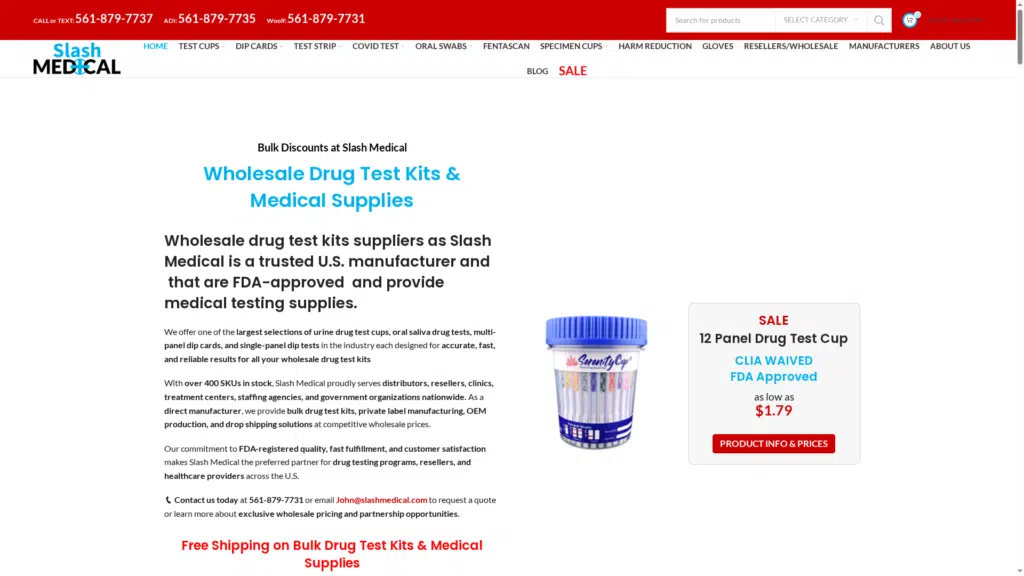
Discover how partnering with Slash Medical lets you streamline bulk purchasing of forensic-grade urine and oral drug test cups, dip cards, and accessories. Benefit from our private label manufacturing and drop shipping solutions tailored to your unique compliance needs. Act now to secure the right forensic testing supplies from a trusted manufacturer and distributor that prioritizes legal admissibility and operational efficiency. Visit Slash Medical to explore our full product catalog and find the perfect match for your forensic testing program.
Frequently Asked Questions
What does “forensic use only” mean in drug testing?
“Forensic use only” indicates that these drug tests are intended solely for legal and court-related purposes, not for routine medical screening or employment decisions.
How do forensic drug tests differ from standard clinical tests?
Forensic drug tests require stricter documentation, confirmatory testing, and chain-of-custody protocols. They are focused on legal admissibility rather than patient diagnosis and treatment.
What are the legal implications of misusing forensic drug test results?
Misusing forensic test results can lead to civil liability, evidence suppression in legal cases, regulatory violations, and potential loss of professional licenses for staff involved.
When should an organization use forensic drug tests?
Forensic drug tests should be used in scenarios like court-ordered drug testing, probation monitoring, DUI investigations, and child custody evaluations, where legal documentation and standards are required.