
7 Key Benefits of CLIA Waived Tests for Treatment Centers

Choosing the right drug testing system for your treatment center can feel overwhelming when time, budgets, and patient care are all on the line. You need solutions that are not only reliable but also practical for your staff and accessible for your patients. The real challenge is finding a testing approach that cuts down wait times, reduces errors, and fits within your facility’s resources without sacrificing quality.
CLIA waived tests are reshaping how clinics like yours deliver care. These tests require minimal training, offer fast results, and help you make informed decisions in real time. You will discover how CLIA waived testing can make your workflow smoother, lower your operating costs, and support your treatment outcomes—all backed by proven facts and expert guidance.
If you want actionable insights you can use right away to improve your testing process, every point on this list will reveal a benefit you might be missing. Stay tuned for the key reasons CLIA waived testing could be the solution your facility needs.
Table of Contents
- 1. Fast and Accurate Results for Immediate Decisions
- 2. Lower Costs for Budget-Conscious Facilities
- 3. Simple Procedures With Minimal Staff Training
- 4. Enhanced Compliance With Regulatory Standards
- 5. Reduced Risk of Laboratory Errors
- 6. Greater Accessibility for On-Site Testing
- 7. Flexibility for Bulk Ordering and Customization Needs
Quick Summary
| Takeaway | Explanation |
|---|---|
| 1. Immediate Results Enhance Decision-Making | CLIA waived tests provide timely results during patient visits, allowing for quick adjustments in treatment plans and improving patient outcomes. |
| 2. Significant Cost Savings for Facilities | Switching to CLIA waived tests can reduce drug testing costs dramatically, reallocating budget towards patient care and support services. |
| 3. Simplicity Reduces Training Needs | CLIA waived tests require minimal training for staff, enabling quick implementation and flexibility in test administration across roles. |
| 4. Improved Regulatory Compliance | Using CLIA waived tests simplifies compliance with federal standards, reducing the risk of audits and regulatory issues for treatment centers. |
| 5. Enhanced Accessibility for Patients | Testing at the point of care removes barriers, allowing for immediate patient engagement and streamlined treatment initiation. |
1. Fast and Accurate Results for Immediate Decisions
When a patient walks into your treatment center, time matters. Every minute of delay in getting test results can affect your clinical decision-making, your patient’s treatment plan, and ultimately their outcomes. This is where CLIA waived tests prove their value, delivering results at the point of care rather than forcing you to wait for a laboratory to process samples.
Traditional drug testing often requires sending samples to a lab, which can take days or even weeks. During that waiting period, clinicians operate with incomplete information. They might hesitate to adjust medications, modify treatment approaches, or make discharge decisions because they lack definitive test results. CLIA waived tests eliminate this bottleneck by providing immediate test results during patient visits, allowing you to make informed decisions right away.
The CDC emphasizes that rapid testing plays an increasingly important role in vital medical decisions by delivering reliable results in real-time. What makes this possible is the simplicity of CLIA waived tests. These are straightforward point-of-care tests that your clinical staff can perform on-site without sending samples away. A urine cup test, oral fluid test, or dip card delivers results within minutes, not days. Your providers get the information they need while the patient is still in your facility, enabling immediate next steps in treatment planning.
Consider a common scenario at your treatment center. A patient arrives for a medication-assisted treatment visit. You need to verify whether they have been using illicit substances to determine if their current treatment protocol is effective or requires adjustment. With a CLIA waived test performed in your clinic, you have results within minutes. You can discuss those results with the patient immediately, adjust their medication if needed, and modify their treatment plan without delay. This immediate feedback loop strengthens accountability and allows you to respond quickly to changes in a patient’s clinical status.
The accuracy of these tests matters just as much as the speed. CLIA waived tests are FDA approved and designed to meet rigorous quality standards. They detect specific substances reliably, giving you confidence in your clinical decisions. You are not making treatment adjustments based on uncertain results or guesswork. You have validated, accurate data that supports your medical judgment.
Another practical benefit is the reduction in missed appointments and follow-up complications. When results are available immediately, patients do not have to return for a second visit to discuss test outcomes. They receive feedback, education, and any necessary treatment modifications during the same visit. This convenience reduces the likelihood of patients dropping out of treatment and improves overall engagement with your program.
Professional tip: Establish a standardized protocol for performing and documenting CLIA waived tests so your staff members follow consistent procedures, maintain chain of custody, and create reliable records for treatment planning and regulatory compliance.
2. Lower Costs for Budget-Conscious Facilities
Budget constraints are a reality for most treatment centers. Whether you run a nonprofit organization, a smaller independent clinic, or a facility serving underinsured populations, every dollar spent on testing is a dollar that cannot go toward clinical staff, patient counseling, or facility improvements. This is where CLIA waived tests offer a significant financial advantage that directly impacts your operational bottom line.
Traditional laboratory testing requires substantial infrastructure. You need certified labs with complex equipment, trained technicians, quality control systems, and expensive accreditation processes. When you send samples to an external lab, you pay per test plus processing fees, shipping costs, and handling charges. These expenses add up quickly, especially for treatment centers running high-volume testing programs. CLIA waived tests eliminate most of these layers of cost because they require far less laboratory infrastructure and fewer operational expenses compared to complex lab testing.
The simplicity of point-of-care testing translates directly into cost savings. A CLIA waived test cup or dip card costs significantly less than sending a sample to a reference laboratory. Your staff performs the test on-site using minimal equipment, no complex machinery, and no specialized training beyond basic competency certification. You avoid shipping fees, turnaround time delays, and the middleman costs that come with traditional lab outsourcing. The per-test cost is lower, and you have better control over your testing budget.
Consider the math for a mid-sized treatment center. If you perform 50 drug tests per week through an external lab at an average cost of 35 to 50 dollars per test, you are spending 1,750 to 2,500 dollars weekly just on testing. That amounts to roughly 91,000 to 130,000 dollars annually. By switching to lower cost CLIA waived testing, you might reduce that per-test cost to 5 to 10 dollars, cutting your annual testing budget to 13,000 to 26,000 dollars. That difference of 65,000 to 117,000 dollars per year can fund additional counseling sessions, hire peer specialists, improve facility conditions, or expand your treatment capacity.
Smaller and resource-limited treatment centers particularly benefit from this cost structure. If you are a startup program or operate in an underserved area where funding is tight, CLIA waived testing makes comprehensive drug screening financially feasible. You do not have to choose between offering quality testing and staying within budget. The affordability and reliability of point-of-care testing work together, supporting efficient budget management without forcing you to compromise on quality or patient safety.
Beyond the direct per-test cost, you save money on infrastructure and staffing. You do not need a dedicated lab facility, specialized lab equipment, or highly trained technicians. Your existing clinical staff members can perform tests as part of their normal patient assessment flow. This efficiency means your resources stretch further. You get more value from your personnel and facility without requiring expensive upgrades or additional hires.
There is also the hidden cost of waiting for results. When results come back days or weeks later, some patients may have already left your program or require additional follow-up visits. Those missed opportunities or extra appointments add costs that compound over time. Fast point-of-care testing keeps patients engaged during their initial visit, reducing the likelihood of costly follow-up complications and dropouts.
“Facilities utilizing CLIA waived tests benefit from lower operational costs due to simplicity of test procedures and minimal equipment requirements, making affordable, reliable testing accessible to smaller or resource-limited treatment centers.”
The return on investment for CLIA waived testing is measurable and quick. You recoup your initial investment in test supplies within months and experience ongoing savings that improve your financial sustainability. This matters especially for treatment centers operating on tight margins or serving populations with limited payment capacity.
Professional tip: Calculate your current annual testing costs including per-test fees, shipping, lab overhead, and personnel time, then compare that to CLIA waived testing costs to quantify your exact savings potential and justify the switch to leadership and stakeholders.
3. Simple Procedures With Minimal Staff Training
One of the biggest obstacles to implementing comprehensive drug testing at treatment centers is the barrier to staff competency. Traditional laboratory testing requires specialized technicians with extensive training in phlebotomy, specimen handling, quality control, and complex analytical procedures. Finding and retaining these professionals is expensive and difficult. CLIA waived tests eliminate this problem entirely because they are designed to be simple and can be reliably performed by your existing clinical staff with minimal training.
The difference in procedural complexity is dramatic. A certified lab technician performing complex testing might need months of training and ongoing education. A CLIA waived test requires your nurse, medical assistant, or counselor to follow straightforward manufacturer instructions. Collect the specimen, apply it to the test device, wait the specified time, read the result. That is it. There is no centrifuging, no calibrating equipment, no interpreting complex instrument readouts, and no specialized chemistry knowledge required. The test either shows a positive or negative result that your staff can immediately understand and document.
This simplicity translates to real operational flexibility. Any competent member of your clinical team can perform the test. Your intake coordinator can conduct testing during patient intake. Your nurses can perform tests as part of medication-assisted treatment monitoring. Your counselors can collect specimens during group sessions. You do not need a dedicated laboratory person or expensive lab coordinator. Your existing personnel simply incorporate testing into their normal workflow with minimal additional training.
Staff training for CLIA waived testing typically takes hours rather than weeks or months. You need to cover the manufacturer instructions, proper specimen collection, result interpretation, documentation requirements, and quality control procedures. Most of this training can be completed in a single session or through brief online modules. Your staff members can be competent and confident within a day or two of instruction. Compare that to the months required to train a laboratory technician, and you see substantial time and cost savings.
The low risk of error when tests are performed according to manufacturer instructions is built into the test design. These tests are engineered for reliability even when handled by people without advanced laboratory training. The CDC emphasizes that waived tests require minimal procedural complexity and can be conducted safely by personnel without extensive laboratory expertise. This is not cutting corners on quality. It is intelligent test design that prioritizes accuracy while reducing unnecessary complexity.
Consider the practical scenario at your facility. A new medical assistant joins your team. Instead of waiting months for laboratory training before they can contribute to your testing program, they can be performing CLIA waived tests within days. This flexibility in staffing is valuable, especially in competitive labor markets where experienced lab technicians are hard to find. You hire good clinical people and train them quickly on your testing procedures rather than limiting your hiring to candidates with specialized lab credentials.
Staff morale also improves when testing procedures are straightforward. Your team members feel confident performing tests because the procedures are clear and standardized. There is no anxiety about making mistakes or misinterpreting complex results. The simplicity creates a sense of competence and ownership. Your staff becomes invested in the testing program because they understand what they are doing and why it matters.
Quality control in CLIA waived testing is also simpler but still rigorous. You run periodic positive and negative controls to verify your tests are working properly. You document results. You maintain chain of custody. But these procedures are straightforward and do not require advanced laboratory knowledge. Your staff can follow your quality control protocol without specialized training.
The ease of implementation also means you can roll out testing quickly across your entire facility. You do not need to hire new personnel or wait for extensive training programs. You can introduce CLIA waived testing within weeks and have your entire team performing tests competently. This rapid deployment improves patient care immediately.
Professional tip: Create a simple one-page quick reference guide for each CLIA waived test you use, with clear step-by-step instructions and common troubleshooting tips, so your staff can refresh their memory anytime without needing to access lengthy training materials.
4. Enhanced Compliance With Regulatory Standards
Regulatory compliance is not optional in healthcare. Treatment centers operate within a complex framework of federal, state, and local regulations designed to protect patient safety and ensure testing quality. CLIA waived tests provide a straightforward pathway to meeting these regulatory requirements while demonstrating your commitment to quality and accountability.
The Clinical Laboratory Improvement Amendments, or CLIA, establish the federal standard for laboratory testing quality and reliability. When you use CLIA waived tests and maintain a Certificate of Waiver, you are operating within a regulatory framework that has already determined these tests are accurate, simple, and low risk. You are not operating in a gray zone or hoping your testing practices are acceptable. You are following a clear, federally established protocol that protects both your patients and your facility.
Obtaining and maintaining a CLIA waiver requires meeting specific federal guidelines for testing simplicity, low risk of error, and proper staff competency. These requirements are not burdensome or expensive. They include basic quality control procedures, staff training documentation, and maintaining records of your testing practices. Your staff performs tests according to manufacturer instructions, you document your quality control procedures, and you keep records of staff competency. That is it. These straightforward practices ensure your testing program meets federal standards.
The benefit to your treatment center is substantial. When regulators or accrediting bodies audit your facility, they can see that you are using FDA-approved, CLIA waived tests and maintaining appropriate documentation. You are not scrambling to justify your testing practices or worrying about whether your procedures meet regulatory standards. You have clear documentation showing compliance with established guidelines. This confidence reduces stress during inspections and demonstrates your professionalism to oversight agencies.
Consider the alternative. If you were using non-waived testing without proper certification or oversight, you would face serious regulatory exposure. State health departments, the Centers for Medicare and Medicaid Services, or accrediting bodies could issue citations, fines, or sanctions. Your treatment center could lose its license or accreditation. Patients could question the validity of your test results. The financial and reputational damage could be catastrophic. CLIA waived tests eliminate this risk by providing clear federal guidance for testing quality and reliability standards.
Maintaining your Certificate of Waiver is straightforward. You register your facility, provide information about the testing you perform, and demonstrate that your staff has received appropriate training on your testing procedures. You perform quality control checks regularly and document the results. You keep personnel records showing your staff has been trained and is competent. These are not complex or time-consuming activities. They are sensible practices that any professional treatment center would implement anyway.
Your compliance posture also matters when dealing with insurance companies, managed care organizations, or government agencies that refer patients to your facility. These entities want assurance that your testing is reliable and meets regulatory standards. When you can demonstrate you are using CLIA waived tests with proper certification and documentation, you strengthen your credibility and your business relationships. Insurance companies are more willing to contract with you. Referral sources trust that your testing results are valid.
Beyond the regulatory framework, compliance with CLIA standards demonstrates your commitment to quality that resonates with patients and their families. When a family member asks whether your facility uses legitimate, FDA-approved testing, you can confidently answer yes. You are not cutting corners or using questionable methods. You are following the same standards that hospitals and major clinical laboratories follow.
The documentation requirements of CLIA compliance also create a beneficial side effect. Your detailed records of testing practices, staff training, and quality control create a clear audit trail that protects you legally. If a test result is ever questioned or becomes relevant in a legal matter, your documentation shows exactly when the test was performed, by whom, what the result was, and how your quality control procedures verified the test was working correctly. This documentation can be invaluable if you ever need to defend your testing practices.
“Obtaining and maintaining a CLIA waiver ensures treatment centers meet federal guidelines for testing simplicity, low risk of error, and proper staff competency, supporting enhanced compliance with regulatory mandates and reducing risk of sanctions.”
Implementing CLIA waived testing is also simpler than managing a more complex testing program with higher regulatory burdens. The Certificate of Waiver is the least complex CLIA certification available. You avoid the extensive quality assurance programs, complex proficiency testing requirements, and specialized personnel requirements that come with higher certification levels. You get compliance without unnecessary burden.
Professional tip: Designate one staff member as your testing compliance coordinator to maintain all CLIA documentation, track staff training dates, manage quality control records, and prepare for regulatory audits, ensuring nothing falls through the cracks.
5. Reduced Risk of Laboratory Errors
Laboratory errors happen more often than most people realize. Complex testing procedures with multiple steps create numerous opportunities for mistakes. A technician might mishandle a specimen, miscalibrate equipment, misinterpret results, or fail to follow proper chain of custody procedures. Any of these errors can produce false positives, false negatives, or invalid results that compromise patient care. CLIA waived tests dramatically reduce this risk by eliminating the procedural complexity that causes errors in the first place.
The design philosophy of CLIA waived tests is fundamentally different from complex laboratory testing. Complex tests require specialized equipment, trained technicians, quality control protocols, and multiple processing steps. Each step introduces potential for error. A CLIA waived test has been engineered to minimize steps and maximize clarity. You collect a specimen, apply it to the test device, wait a specified time, and read the result. That simplicity is not a weakness. It is a strength that reduces error risk.
Simplified procedures mean fewer opportunities for human error to occur. When a procedure has 20 steps, each step presents a chance for something to go wrong. A CLIA waived test typically has 5 or fewer steps. The manufacturer has already done the engineering work to make the test foolproof. The test components are pre-calibrated. The detection reagents are pre-measured. Your staff simply follows clear, straightforward instructions. Designed to minimize risk of error, CLIA waived tests achieve reliability through simplicity rather than complexity.
Manufacturer instructions for CLIA waived tests are crystal clear because they must be. The FDA requires that waived tests be simple enough for non-laboratory personnel to perform reliably. This means the instructions cannot be vague or technical. They must be explicit, step by step, with clear visual cues and obvious result interpretation. Your staff follows the same instructions every time, eliminating variation that can lead to errors.
Consider a typical scenario where errors occur in complex laboratory testing. A technician is processing multiple samples. They are tired from a long shift. They are rushing to meet a deadline. A sample gets mislabeled. A result gets transposed into the wrong patient’s chart. A quality control procedure is skipped because the lab is understaffed. These are real problems that occur regularly in complex laboratory environments. CLIA waived testing eliminates most of this risk because the procedures are simple enough that fatigue, rushing, and understaffing are far less likely to cause errors.
Quality control for CLIA waived tests is also simpler and more effective. You run a positive and negative control periodically to verify your tests are working. You document that you did it. That is quality control. You are not managing complex instrument calibrations or troubleshooting complicated equipment failures. You are verifying that your tests produce expected results when you know what the answer should be. This straightforward approach catches problems before they affect patient results.
False positive results are particularly problematic in treatment centers. A false positive drug test can have serious consequences for a patient. It can affect their treatment plan, their legal status, or their employment. A false negative might mean you miss genuine substance use that requires treatment adjustment. CLIA waived tests reduce false results through inherent simplicity and design reliability. The test chemistry is straightforward. The result is binary. Positive or negative. No ambiguous gray zones requiring interpretation.
Chain of custody errors also decrease with CLIA waived testing. When specimens are processed on-site immediately after collection, you eliminate many chain of custody complications. You do not need to package specimens, label them, send them away, track them through a lab, and wait for results. You collect the specimen and test it within minutes in the same room. This direct approach removes opportunities for specimens to be lost, mislabeled, or contaminated during transport.
Staff competency also supports error reduction. Because CLIA waived testing is simple, your staff can be reliably competent. After brief training, they understand the procedure thoroughly. They perform it the same way every time. They are not struggling with complex equipment or trying to remember detailed technical procedures. This consistency reduces errors because there is less variation in how tests are performed.
The financial impact of errors cannot be ignored. A false positive result might lead to unnecessary treatment adjustments or additional testing. A false negative might allow substance use to continue undetected. Either result creates complications that increase costs and compromise patient outcomes. By reducing error risk through simpler procedures, CLIA waived testing protects both your patients and your budget.
Your reputation also depends on test accuracy. If word gets around that your facility produces unreliable test results, referrals dry up and patient trust erodes. CLIA waived tests protect your reputation by delivering consistent, reliable results. Your patients and referring physicians know they can trust the results your facility produces.
Professional tip: Implement a simple verification protocol where a second staff member independently confirms the result interpretation of every positive test result before it is reported to the patient, providing a built in error check that catches the rare misread result.
6. Greater Accessibility for On-Site Testing
Traditional laboratory testing creates a fundamental accessibility problem. Patients must travel to a lab facility, wait in line, have blood drawn or samples collected by trained phlebotomists, and then wait days for results. This process is inconvenient, creates barriers to care, and delays clinical decision making. CLIA waived tests solve this problem by bringing testing directly to your treatment center, enabling you to conduct comprehensive drug screening wherever your patients are being treated.
The portability of CLIA waived tests is revolutionary in its simplicity. A test cup fits in your hand. A dip card takes up the space of a business card. An oral fluid test requires no needle, no special collection equipment, and no trained technician. Your staff can perform testing in an intake office, a counseling room, a group therapy space, or even an outreach location. There is no need for dedicated laboratory space, complex infrastructure, or specialized facilities. You test patients where they are being seen.
This accessibility transforms your capacity to serve patients. Consider an outreach program that meets patients in the community at shelters, community centers, or mobile clinics. With CLIA waived tests, you can conduct drug screening on the spot, allowing you to assess patients in real time and connect them with treatment immediately. Without portable point-of-care testing, you would need to refer patients to a lab, creating friction that many patients never overcome. They disappear into the community without ever entering your treatment program. Portable testing in non-traditional settings enables you to meet patients where they are and engage them while motivation is high.
On-site testing also eliminates a major barrier for patients with chaotic life circumstances. A patient in active addiction may struggle to navigate multiple appointments or travel to distant lab facilities. When you can test them during their first clinic visit, you remove barriers and streamline engagement. You collect the information you need, make treatment decisions, and start care immediately. This efficiency dramatically improves treatment entry rates and patient engagement.
Accessibility also benefits your operational flexibility. You are not dependent on lab hours, weekend closures, or holiday schedules. You can test patients whenever your facility is open. An evening intake appointment that used to require scheduling a lab draw appointment can now be completed on site. A weekend group session where you notice a patient may have relapsed can include immediate testing and clinical response. This flexibility supports better patient care and more responsive treatment planning.
The speed of on-site testing increases accessibility in another crucial way. Results within minutes mean patients do not have to make multiple visits. They come for their appointment, get tested, receive results, discuss implications, and move forward with treatment planning all in one visit. This consolidation of care reduces the burden on patients and increases the likelihood they will follow through with treatment recommendations.
On-site testing also improves accessibility for patients with mobility limitations, transportation challenges, or physical disabilities. An elderly patient or a patient with a chronic illness may find traveling to a lab facility exhausting or impossible. Testing in your clinic removes this barrier. A patient without reliable transportation no longer needs to solve the logistical puzzle of getting to a separate lab facility. You bring testing to them.
Your treatment program also becomes more accessible to underserved populations. Rural areas, low-income neighborhoods, and communities with limited healthcare infrastructure often struggle to access laboratory services. CLIA waivers allow treatment facilities to legally perform point-of-care tests without complex laboratory infrastructure, expanding your capacity to serve these populations. You can operate comprehensive treatment programs in areas that would otherwise have no access to drug screening services.
Accessibility extends to your ability to respond quickly to clinical situations. A patient discloses relapse risk or shows signs of substance use. Rather than scheduling a separate lab appointment and waiting for results, you can test immediately and respond clinically on the same day. This responsiveness strengthens your treatment relationships and demonstrates your commitment to patient care.
Staff accessibility also improves. Your nurses, counselors, and medical assistants can incorporate testing into their normal workflow without needing to coordinate with a separate lab or external testing facility. Testing becomes a seamless part of your treatment program rather than an external service you have to manage separately. Your staff gains the autonomy and efficiency of conducting testing as part of their direct patient care.
The accessibility benefit also applies to documentation and follow-up. When testing happens on-site with immediate results, your clinical notes flow naturally. You document the test, the result, and the clinical response all in the same clinical encounter. There is no fragmentation across multiple appointments or external reports that need to be tracked down later. Your medical records are more complete and coherent.
Professional tip: Place CLIA waived test supplies in multiple convenient locations throughout your facility so patients do not have to travel to a single testing room, making the experience seamless and removing any perception that testing is burdensome or inconvenient.
7. Flexibility for Bulk Ordering and Customization Needs
Every treatment center has unique testing needs based on their patient population, treatment modalities, and clinical protocols. A medication-assisted treatment program may prioritize opioid and benzodiazepine testing. A residential program serving adolescents might need different panels than an adult outpatient clinic. A dual diagnosis facility needs comprehensive screening. Rather than forcing you into a one-size-fits-all testing approach, CLIA waived tests offer remarkable flexibility through bulk ordering options and customizable test combinations.
Manufacturers and distributors recognize that treatment centers operate differently. Some facilities need 5-panel tests. Others need 10 or 12-panel configurations. Some want to include adulterant testing to detect specimen tampering. Others need oral fluid tests for patients who cannot provide urine specimens. Rather than limiting you to standardized products, the market offers a broad variety of test types and platforms that can be customized to match your specific clinical requirements.
Bulk ordering dramatically reduces your per-unit costs while ensuring you never run out of tests. Instead of buying small quantities at higher prices, you can order cases or pallets of tests at volume discounts. This approach gives you better pricing power and more reliable inventory management. You know you have sufficient tests on hand to support your patient volume without gaps that force you to delay testing or rush to emergency orders at premium prices.
Customization options allow you to match your test selection to your actual patient needs. If your facility specializes in opioid addiction treatment, you can customize your bulk order to emphasize opioid-specific tests. If you serve a population with stimulant use disorders, you can include amphetamine and methamphetamine testing in your standard panels. If you need to screen for emerging substances like fentanyl or synthetic cannabinoids, you can select test combinations that include those substances. Broad variety of test types and platforms enables you to create testing protocols tailored to your patient population.
The flexibility extends to test formats as well. Some patients prefer urine testing. Others are more comfortable with oral fluid tests. Some facilities want rapid test cups for convenience. Others prefer dip cards for flexibility in handling specimens. Rather than committing to a single format, you can order a mix that accommodates different preferences and clinical situations. A patient who cannot provide a urine specimen can be tested with oral fluid. A patient in crisis can be tested quickly using a rapid cup test. Your staff has options.
Customization also applies to panel configurations. A standard 5-panel test checks for marijuana, cocaine, amphetamines, opioids, and phencyclidine. But you might want to add benzodiazepines or barbiturates relevant to your patient population. You might want to include synthetic opioid panels that detect fentanyl and its analogs. Manufacturers offer these customized combinations, and bulk ordering makes them cost-effective. You do not pay for tests you do not need, and you get exactly the substances you want to screen.
Adulterant testing is another customization option that matters for treatment centers. Specimen integrity testing detects whether a urine sample has been diluted, substituted, or otherwise compromised. If specimen adulteration is a problem at your facility, you can bulk order tests with built-in adulterant detection. If it is not a concern, you can skip this feature and reduce costs. The flexibility allows you to optimize your spending based on your actual operational needs.
Bulk ordering also simplifies your procurement process. Rather than placing multiple small orders throughout the year, you can negotiate a bulk purchase agreement with a distributor. This reduces the administrative burden of ordering, simplifies invoicing, and gives you better pricing predictability. You know your test costs per unit and you can budget accordingly. There are no surprises or emergency expedited orders that disrupt your financial planning.
Storage and inventory management improve with bulk ordering. You can stock tests at multiple sites within your facility if you have several clinics or treatment locations. You ensure that testing supplies are always available wherever patients are being seen. You do not have to coordinate testing around limited supply availability. Your staff has the tests they need when they need them.
The customization flexibility also supports program evolution. As your treatment program grows or changes, you can adjust your test orders to match. If you add medication-assisted treatment services, you can add benzodiazepine testing to your bulk order. If you expand into adolescent services, you can customize your panels to match adolescent screening protocols. Your testing approach grows with your program rather than constraining your program development.
Cost savings from bulk ordering and customization can be reinvested in other treatment services. The money you save on per-unit testing costs through volume purchasing can fund additional counseling, hire peer specialists, improve your facility, or extend your hours of operation. Manufacturers and distributors commonly provide options for bulk purchasing and customized combinations, enabling you to optimize test availability and reduce ordering costs simultaneously.
“Bulk ordering and customization options allow treatment centers to tailor their testing approach precisely to their patient population and operational needs while achieving significant cost savings through volume purchasing.”
Negotiating with your distributor is also easier when you commit to volume. They know you are a reliable customer ordering significant quantities. They are more willing to work with you on pricing, customization options, and service terms. You gain a business partner rather than just a vendor.
Professional tip: Analyze your testing volume over the past 12 months to identify which test types and panels you use most frequently, then propose a customized bulk order based on actual usage patterns to maximize cost savings while ensuring you always have the tests your clinical team needs.
Below is a comprehensive table summarizing the benefits and details of implementing CLIA waived testing as discussed in the article.
| Category | Details | Benefits and Impacts |
|---|---|---|
| Fast Results and Decisions | CLIA waived tests deliver immediate results during patient visits. | Enables informed decision-making and immediate treatment plan adjustments. |
| Cost Savings | These tests are financially manageable by reducing infrastructure, operational expenses, and shipping fees. | Allows facilities to reallocate resources to other necessary services, improving financial sustainability. |
| Ease of Implementation | Requires minimal training for staff to perform standardized tests. | Reduces training time and operational complexity, enhancing flexibility and efficiency. |
| Regulatory Compliance | Maintains adherence to federal guidelines through Certificate of Waiver procedures. | Demonstrates quality assurance, mitigates risk, and secures reliable documentation for audits. |
| Error Reduction | Structured for simplicity to minimize mismanagement or misinterpretations in results. | Increases accuracy and reliability of testing outcomes. |
| Accessibility | Portable tests facilitate on-site or outreach program-based assessments. | Eliminates logistical barriers, improving patient engagement and retention. |
| Customization Options | Offers customizable test panels and bulk ordering provisions to match clinic requirements. | Enhances cost management and adaptability to evolving treatment needs and population profiles. |
Unlock the Full Potential of CLIA Waived Testing with Slash Medical
Treatment centers face the tough challenge of delivering fast, accurate, and cost-effective drug testing without sacrificing quality or compliance. This article highlighted how CLIA waived tests provide immediate results, lower operational costs, and simplified staff training while enhancing regulatory adherence and reducing errors. These are exactly the pain points Slash Medical is built to solve. With over 400 FDA-approved and CLIA waived drug test kits including urine cups, oral fluid tests, and customizable panels, we supply the reliable, affordable, and flexible testing solutions your program needs to improve patient care and streamline your workflow.
Slash Medical makes bulk ordering easy for your treatment center with volume discounts, private label options, and nationwide shipping. Whether you need 5-panel or specialized adulterant test kits, our platform empowers you to meet your unique clinical demands while confidently maintaining compliance standards. Discover how to match your testing protocols with trusted products from a direct manufacturer and distributor committed to your success.
Take the next step now and explore our comprehensive selection to transform your drug testing program. Visit Slash Medical and browse our complete catalog today.
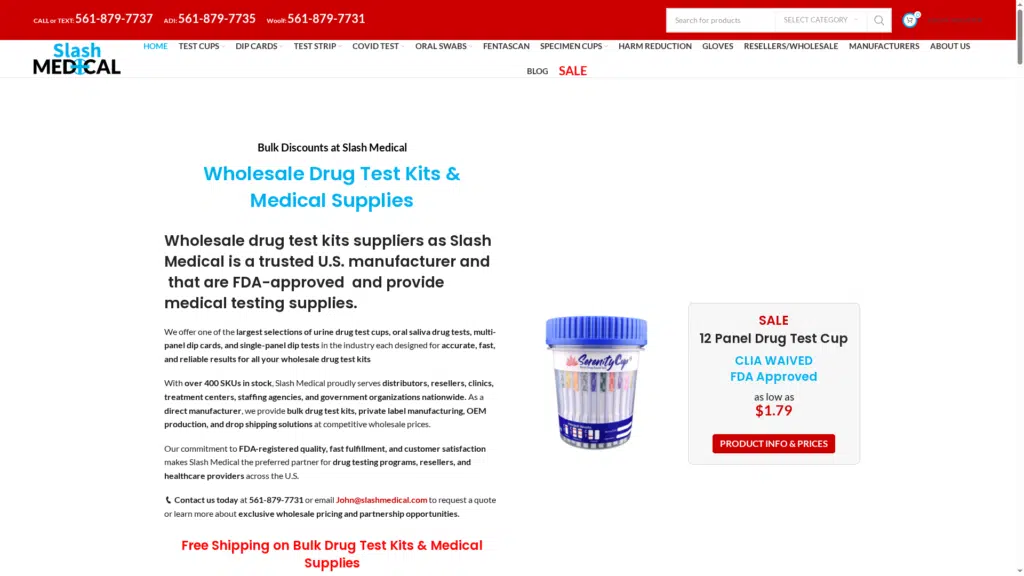
Order smarter, save more, and deliver better patient care with Slash Medical. Start optimizing your CLIA waived testing supplies by visiting our website now to get bulk pricing and personalized service that your treatment center deserves.
Frequently Asked Questions
What are CLIA waived tests and how do they benefit treatment centers?
CLIA waived tests are simple, point-of-care tests that meet federal standards for accuracy and reliability. They deliver immediate results, allowing treatment centers to make timely clinical decisions without waiting for laboratory processing.
How can CLIA waived tests reduce operational costs for treatment centers?
CLIA waived tests eliminate the need for complex laboratory facilities and specialized staff, significantly reducing testing costs. By switching to these tests, treatment centers can lower annual testing budgets by up to 65%, allowing funds to be redirected toward patient care services.
What kind of training is needed for staff to perform CLIA waived tests?
CLIA waived tests require minimal training, with staff typically becoming competent within just a few hours. Training focuses on basic procedures such as specimen collection and result interpretation, making implementation quick and efficient.
How quickly can treatment centers implement CLIA waived testing?
Treatment centers can begin using CLIA waived tests within weeks, as the procedures are straightforward and can be easily integrated into existing workflows. Set up a standard protocol and train your staff to start testing as soon as possible.
What steps should facilities take to ensure compliance with CLIA standards?
Facilities need to maintain documentation of staff training, perform regular quality control checks, and keep detailed records of testing practices. By following these simple procedures, treatment centers can ensure compliance and avoid regulatory risks.
How do CLIA waived tests enhance patient engagement in treatment programs?
The immediacy of results from CLIA waived tests reduces the number of follow-up visits needed for test results, enhancing patient engagement during their initial appointment. This streamlined process can improve treatment entry rates and overall patient satisfaction.