
Staffing Agencies and Drug Screening: Ensuring Safe Hiring

Every Human Resources manager in the staffing industry knows that one unreliable placement can unravel months of hard work. Drug screening is your frontline defense against workplace accidents, liability, and compliance violations. With agencies serving as the crucial link between employers and job candidates, a strong drug screening program is more than a legal requirement—it is your agency’s reputation on the line. This guide explores how optimizing your drug screening protects both your clients and the American workforce.
Table of Contents
- Staffing Agencies’ Role in Drug Screening
- Types of Drug Tests Used by Agencies
- Key Steps in the Screening Process
- Legal and Compliance Obligations for HR
- Challenges and Best Practices for Efficiency
Key Takeaways
| Point | Details |
|---|---|
| Importance of Drug Screening | Staffing agencies play a crucial role in ensuring workplace safety and legal compliance through effective drug screening programs. |
| Pre-Employment Testing | Conducting thorough pre-employment drug tests helps identify substance abuse early and saves time and resources for both the agency and employers. |
| Adherence to Regulations | Agencies must comply with federal and state drug testing laws to avoid legal repercussions and maintain a good reputation. |
| Benefits of Transparent Policies | Clearly communicating drug testing policies to candidates fosters trust and reduces potential disputes during the hiring process. |
Staffing Agencies’ Role in Drug Screening
Staffing agencies serve as gatekeepers between employers and potential employees, making drug screening a cornerstone of their hiring responsibility. Your agency’s drug screening programs directly impact workplace safety, productivity, and legal compliance for your client companies.
Staffing agencies are instrumental in implementing workplace substance use prevention through strategic drug screening. This role goes far beyond simple compliance checks—it’s about protecting both workers and employers from preventable incidents.
Why Your Screening Program Matters
Three core responsibilities define your agency’s role in drug screening:
- Conduct pre-employment tests to verify candidates can safely perform assigned duties
- Screen candidates before placement, especially in safety-sensitive industries like construction, transportation, and manufacturing
- Reduce workplace accidents and liabilities by identifying substance misuse early
Your screening program directly addresses workforce safety. When candidates understand your agency conducts rigorous drug tests, problematic applicants often self-select out of the process. This saves time and resources.
Drug testing also reduces productivity losses tied to absenteeism and impaired performance. Employers know that candidates placed through your agency have already cleared screening checkpoints.
Your Agency’s Competitive Advantage
Staffing agencies that prioritize drug screening build stronger relationships with client companies. Employers increasingly expect their staffing partners to handle pre-employment testing as part of standard practice.
This becomes a selling point. When pitching your services, you can confidently say your placements come pre-screened for substance use. Clients appreciate one less compliance headache.
Your drug screening program protects both your reputation and your clients’ operations—making it a business investment, not just a compliance requirement.
Practical Implementation for Your Agency
Effective drug screening requires proper testing supplies and clear processes. Working with a reliable supplier ensures you have consistent access to FDA-approved, CLIA-waived testing products.
Your hiring team should maintain detailed records of all tests conducted, results, and candidate outcomes. Documentation protects your agency from liability claims and demonstrates due diligence to regulators.
Consider implementing a tiered screening approach:
- Initial screening during application review (phone interviews)
- Pre-employment drug test before final placement
- Post-placement random testing for ongoing contracts (where permitted)
Communicate your testing policies transparently to all candidates upfront. Clear expectations reduce disputes later.
Pro tip: Partner with a supplier offering bulk purchasing and drop-shipping solutions so you can scale your screening program as your agency grows without managing inventory yourself.
Types of Drug Tests Used by Agencies
Staffing agencies choose from multiple drug testing methods, each with distinct advantages and detection windows. Your selection depends on industry requirements, candidate volume, budget, and how quickly you need results.
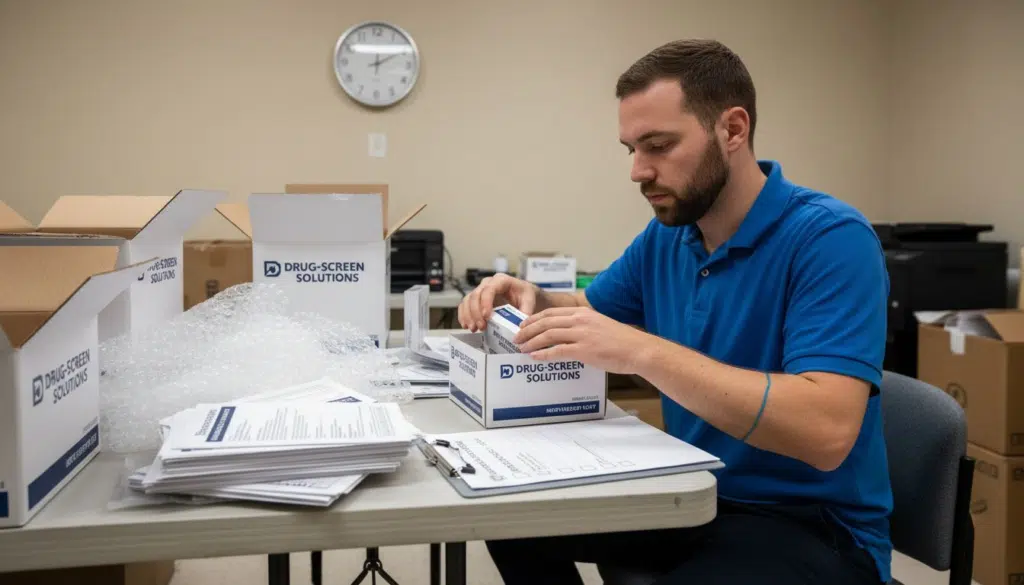
The most common approach involves urine testing, which remains the standard across most industries. Urine tests detect substance use within 1 to 72 hours and offer the best balance of cost and reliability for most staffing operations.
Testing Methods Your Agency Can Use
Five primary testing methods provide different detection capabilities:
- Urine tests: Most cost-effective and widely accepted; detects use within 1 to 72 hours
- Oral fluid (saliva) tests: Detect very recent use indicative of active impairment; gaining popularity for safety roles
- Hair tests: Longest detection window up to 90 days; shows historical use patterns
- Blood tests: Measure current drug levels in the bloodstream; most accurate but invasive
- Sweat patch testing: Worn for extended periods; captures ongoing substance use
Oral fluid tests are increasingly popular among staffing agencies placing workers in safety-sensitive roles like construction and transportation. These tests catch recent impairment more effectively than older methods.
Below is a comparison of drug testing methods to help agencies select the best fit for each scenario:
| Testing Method | Detection Window | Best Use Case | Relative Cost |
|---|---|---|---|
| Urine | 1–72 hours | Standard pre-employment | Low |
| Oral Fluid (Saliva) | Up to 24 hours | Recent use, safety-sensitive | Moderate |
| Hair | Up to 90 days | Historical use detection | High |
| Blood | Few hours to days | Confirm current impairment | Very High |
| Sweat Patch | 7–14 days (avg.) | Long-term monitoring | High |

Matching Tests to Your Placement Needs
Your choice should align with job requirements. Different drug testing methods serve specific purposes depending on when you need results and what information matters most.
For most staffing placements, urine testing handles your pre-employment screening needs. It’s reliable, affordable, and candidates expect it.
For safety-sensitive positions requiring real-time impairment detection, oral fluid testing provides faster turnaround. Results often come back within hours rather than days.
Hair testing works when you need to assess longer-term substance use patterns or when candidates might claim recent abstinence.
Urine testing remains the industry standard because it offers reliable detection, reasonable cost, and faster results than most alternatives.
Building Your Testing Program
Most agencies implement tiered testing protocols based on position risk level. Lower-risk administrative roles use basic urine screening, while safety-sensitive positions receive more comprehensive testing.
Document which test type applies to which job category. This consistency protects your agency and sets clear expectations with candidates.
Consider offering 5-panel and 12-panel test options depending on client specifications. Five-panel tests screen for the most common substances, while 12-panel tests provide broader coverage for industries with strict requirements.
Ensure your testing supplies are FDA-approved and CLIA-waived for accurate, legally defensible results.
Pro tip: Stock multiple test formats at different panel levels so you can quickly match client requirements without special orders or delays.
Key Steps in the Screening Process
A solid screening process protects your agency, your clients, and candidates. Each step must follow legal requirements and industry standards to ensure defensible results and fair treatment.
The process typically begins once a candidate receives a conditional offer of employment. From that point forward, timing and documentation become critical to avoid legal exposure.
Step-by-Step Screening Workflow
Follow this sequence to conduct effective drug screening:
- Provide written notification explaining the drug test requirement and procedure
- Verify candidate identity at the collection site before testing begins
- Explain the collection procedure and answer questions candidly
- Conduct private sample collection with tampering prevention measures
- Check sample temperature to confirm legitimacy
- Seal and label the sample with secure documentation
- Maintain detailed chain-of-custody records throughout handling
- Send samples to certified lab for analysis and confirmation
- Review results confidentially before sharing with candidate
- Provide opportunity for candidate to explain or contest positive findings
Each step requires attention to detail. Skipping procedures creates liability and potentially invalidates results.
Collection and Chain-of-Custody Procedures
Identity verification starts the process. Confirm the candidate is who they claim to be before collecting any sample. This prevents sample switching or fraud. Private collection with sample integrity measures ensures accurate results. Temperature checks confirm the sample is fresh and uncontaminated.
Once collected, the sample gets sealed and labeled with unique identifiers. This labeling connects the sample directly to the candidate and prevents mix-ups.
Chain-of-custody documentation tracks every person who handled the sample and when. This creates an unbroken record that protects your agency legally.
Lab Analysis and Result Communication
Initial test results can show positive, negative, or inconclusive findings. Positive results must undergo confirmatory testing by certified labs before you take any action.
Results remain confidential. Share them only with the candidate and authorized client representatives, never with other staff or candidates.
Chain-of-custody documentation is your legal protection—it proves every step followed protocol and no sample tampering occurred.
Handling Positive Results
When a candidate tests positive, they have the right to explain or dispute the result. Allow them to provide context or request retesting if they believe the result is incorrect.
Document their response in writing. This protects both your agency and the candidate if disputes arise later.
Refusal to test carries the same weight as a positive result. A candidate who refuses can have their employment offer withdrawn without penalty to your agency.
Pro tip: Create a standard form documenting each step of your screening process, including candidate signature acknowledgment, so you have proof of compliance if results are ever challenged.
Legal and Compliance Obligations for HR
Drug screening programs operate in a complex legal landscape. Your HR department must balance workplace safety with federal and state laws protecting employee rights, or face significant liability.
Understanding your obligations protects your agency from lawsuits, regulatory penalties, and reputational damage. Ignorance of these requirements is not a defense.
Federal Laws Governing Drug Testing
Several federal statutes directly impact your testing program:
- Drug-Free Workplace Act: Mandates drug testing policies for employees in federally funded positions
- Americans with Disabilities Act (ADA): Protects employees with past substance abuse who are in recovery
- Title VII of the Civil Rights Act: Prevents discrimination based on protected classes during testing
- Family and Medical Leave Act (FMLA): Requires employers to support addiction treatment leave requests
- HIPAA: Protects confidentiality of medical and drug test information
Your staffing agency must comply with federal and state drug testing laws or face serious consequences. Each jurisdiction adds its own requirements.
Key Compliance Requirements
Three critical compliance steps protect your agency:
- Obtain written consent from every candidate before conducting any drug test
- Maintain strict confidentiality of all results, sharing only with authorized parties
- Apply policies consistently to all candidates in the same position without exception
Inform candidates about your drug testing policy before they apply. Transparency prevents disputes and demonstrates good faith.
Provide education and training to your hiring staff about testing procedures, legal requirements, and anti-discrimination rules.
Protected Employee Considerations
The ADA protects employees with past substance abuse who are currently in recovery or seeking treatment. You cannot automatically disqualify someone based solely on their history.
Consider reasonable accommodations for candidates disclosing addiction treatment needs. This might include flexible scheduling during early recovery.
Do not test based on disability status, race, national origin, gender, or other protected characteristics. Testing must apply uniformly to all candidates in equivalent roles.
Failure to comply with ADA, Title VII, or FMLA protections can result in discrimination lawsuits costing your agency thousands in legal fees and settlements.
Confidentiality and Record Keeping
Drug test results are medical information. Store them separately from personnel files and limit access to those with a legitimate business need.
Maintain detailed records of your testing policies, procedures, and individual test results for at least three years. These documents prove compliance if regulators investigate.
Share results only with the candidate tested and authorized client representatives. Never disclose results to coworkers, other candidates, or the public.
Use this summary to understand main compliance risks and mitigation strategies:
| Compliance Risk | Potential Consequence | Mitigation Strategy |
|---|---|---|
| Insufficient consent | Lawsuits, lost reputation | Always obtain written permission |
| Breach of confidentiality | Regulatory fines, lawsuits | Limit access and use secure storage |
| Inconsistent testing | Discrimination claims | Apply policies to all candidates |
| Inadequate documentation | Failed audits, penalties | Maintain clear, dated records |
Pro tip: Consult with an employment attorney to review your drug testing policy before implementation, ensuring it complies with all federal, state, and local laws specific to your jurisdiction.
Challenges and Best Practices for Efficiency
Running an effective drug screening program requires balancing multiple competing demands. You face pressure to move candidates quickly while maintaining legal compliance, accuracy, and fairness.
Most staffing agencies struggle with cost management, varying state regulations, and the need to process high candidate volumes without sacrificing quality.
Common Challenges Your Agency Faces
Regulatory complexity tops the list. Each state has different drug testing laws, and some jurisdictions restrict certain testing methods or require specific notice periods.
Cost concerns come second. Screening supplies, lab fees, and administrative time add up fast when processing dozens of candidates weekly.
Test accuracy matters too. False positives waste time and damage candidate relationships. You need reliable screening tools to avoid these costly mistakes.
Managing candidate relations during the screening process creates tension. Candidates may feel anxious or defensive about testing, affecting your agency’s reputation.
Best Practices for Streamlined Screening
Establish clear written policies outlining your drug testing procedures, which drugs you screen for, and how you handle results. Consistency prevents legal disputes and builds credibility with clients.
Train your hiring supervisors to recognize impairment signs and understand testing procedures. Well-trained staff catch problems early and handle candidates professionally.
Select validated screening tools matched to your industry’s actual risks. Not every agency needs 12-panel tests; match your screening intensity to job requirements.
Optimizing Your Testing Process
Invest in technology to manage results and documentation efficiently. Digital tracking systems reduce paperwork, improve accuracy, and create audit trails proving compliance.
Standardize your procedures so every candidate experiences identical screening. This consistency protects you legally and ensures fair treatment across your placements.
Build relationships with reliable labs offering quick turnaround times. Faster results mean faster hiring and better candidate experience.
Validated screening tools combined with consistent procedures reduce false positives, save money, and build confidence with your client companies.
Quality Control and Continuous Improvement
Regularly evaluate your screening program’s effectiveness. Are results accurate? Are you catching problems? Are candidates satisfied with the process?
Conduct periodic audits of your testing records to ensure compliance with your documented policies and applicable laws.
Stay current on state law changes affecting drug testing. Subscribe to HR compliance updates so you catch regulatory changes before they impact your operations.
Pro tip: Partner with a wholesale testing supplier offering bulk pricing and consistent product availability, so you can maintain inventory without overstocking while keeping screening costs predictable and low.
Streamline Your Staffing Agency’s Drug Screening with Reliable Supplies
The challenges of managing a compliant, effective drug screening program are clear from the article. Staffing agencies must juggle candidate volume, legal obligations, and accurate, timely results without sacrificing quality or risking liability. You need FDA-approved, CLIA-waived drug tests that match your clients’ safety requirements and streamline your screening process. Whether you require urine cups, oral fluid test kits, or multi-panel dip cards, having a dependable supplier is essential to maintain consistency and confidence.
Boldly protect your agency’s reputation and client relationships by partnering with Slash Medical. With over 400 SKUs designed specifically for staffing and clinical use, bulk purchasing options, private label manufacturing, and nationwide drop shipping, Slash Medical empowers you to build a scalable, cost-effective drug screening program. Access competitive pricing and detailed product information easily at Slash Medical and be ready to meet every client’s testing demands rapidly.
Take control of your drug screening operations today and ensure your candidates are thoroughly and fairly tested with trusted supplies.
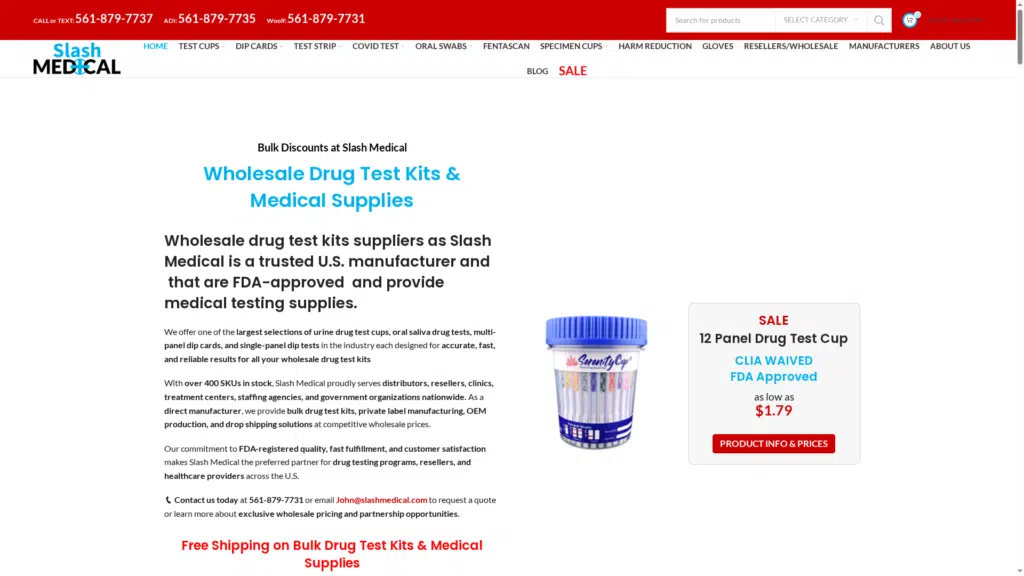
Discover how Slash Medical’s extensive catalog and tailored solutions can simplify your staffing agency’s drug testing needs. Visit Slash Medical now and start securing safer placements with complete confidence.
Frequently Asked Questions
What is the importance of drug screening in staffing agencies?
Drug screening is crucial for staffing agencies as it ensures workplace safety, reduces liability risks, and maintains compliance with legal requirements. It helps identify substance misuse before candidates are placed in safety-sensitive positions.
What types of drug tests are commonly used by staffing agencies?
Staffing agencies typically use urine tests, oral fluid tests, hair tests, blood tests, and sweat patch testing. Each method has different detection windows and use cases, allowing agencies to select the best fit for their specific needs.
How should staffing agencies handle positive drug test results?
When a candidate tests positive, they have the right to explain or contest the result. Agencies should document the candidate’s response and provide information for retesting if necessary. It’s also crucial to maintain confidentiality throughout the process.
What legal obligations do staffing agencies have regarding drug screening?
Staffing agencies must comply with federal laws such as the Drug-Free Workplace Act, the Americans with Disabilities Act, and Title VII of the Civil Rights Act. They must obtain written consent for testing, maintain confidentiality of results, and apply testing policies consistently to avoid discrimination claims.