
Storing Drug Test Kits Safely: Ensuring Compliance
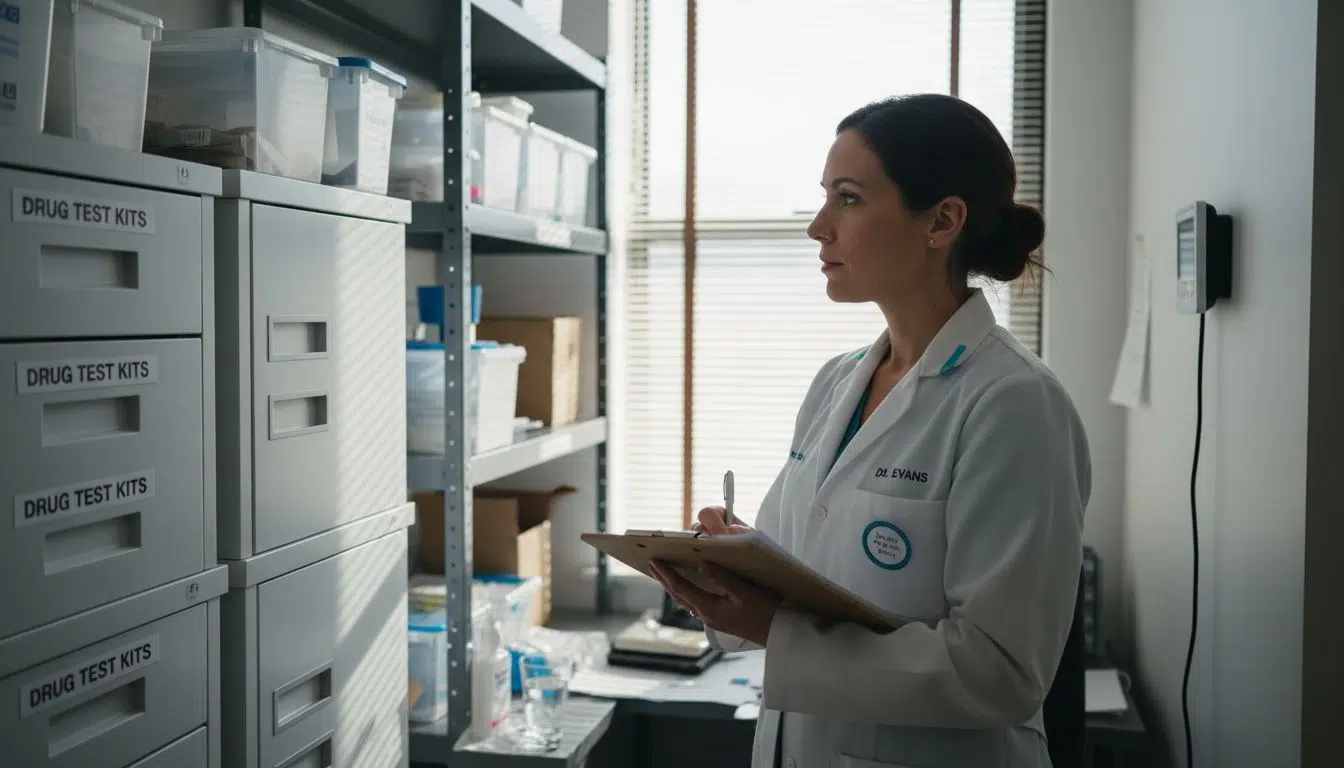
Storing drug test kits in healthcare clinics is more than just placing boxes on a shelf. Safe storage means maintaining conditions that preserve the drug test kits’ potency, preventing contamination, degradation, and loss of efficacy over their shelf life, in accordance with regulatory requirements and good manufacturing practices. For procurement officers, getting storage right supports compliance with United States Food and Drug Administration guidelines and keeps every test result trustworthy for patients, auditors, and your entire organization.
Table of Contents
- What Safe Drug Test Kit Storage Means
- Types of Drug Test Kits and Their Needs
- Manufacturer and Regulatory Storage Guidelines
- Environmental Risks and Common Mistakes
- Best Practices for Secure Storage Procedures
Key Takeaways
| Point | Details |
|---|---|
| Proper Storage Conditions | Maintaining specific temperature, humidity, and light conditions is essential for the accuracy and reliability of drug test kits. |
| Compliance with Regulations | Adhering to manufacturer and regulatory guidelines is crucial for ensuring test validity and avoiding legal liabilities. |
| Segregation of Kit Types | Different drug test kits require tailored storage conditions; grouping them by their specific needs prevents degradation. |
| Documentation and Monitoring | Regularly document environmental conditions and provide staff training to maintain compliance and protect product integrity. |
What Safe Drug Test Kit Storage Means
Safe drug test kit storage is not a one-size-fits-all concept. It refers to the deliberate practice of maintaining your testing supplies under specific environmental conditions that preserve their accuracy and reliability. This means controlling temperature fluctuations, managing humidity levels, minimizing light exposure, and preventing physical damage or contamination. When you store kits properly, you’re ensuring that every test your clinic or treatment center administers delivers valid, dependable results that patients and regulatory bodies can trust.
At its core, safe storage protects the chemical integrity of your test kits. The reagents and materials inside drug test cups, dip cards, and test strips are sensitive to their surroundings. Temperature swings cause chemical reactions within the kit components. Excessive humidity can degrade the reactive materials that produce test results. UV light exposure accelerates breakdown of critical compounds. When these elements deteriorate, your kits become unreliable, producing false negatives or false positives that compromise patient care and clinical decision-making. That’s why manufacturers provide detailed storage instructions specific to each product type.
Compliance with storage requirements isn’t optional for procurement officers managing testing programs. Regulatory bodies including the FDA and state health departments explicitly require that healthcare facilities follow environmental storage guidelines to maintain product efficacy throughout the shelf life. Your facility’s accreditation, licensing, and legal standing depend on documented adherence to these standards. When auditors review your operations, they examine your storage practices alongside your test results. Poor storage documentation creates liability exposure for your organization and undermines the credibility of your entire testing program.
Proper storage encompasses three key dimensions:
- Temperature control prevents chemical degradation and maintains reagent stability. Most drug test kits require storage between 59-86 degrees Fahrenheit (15-30 degrees Celsius), though some products have tighter ranges. Freezing damages materials. Heat accelerates breakdown.
- Humidity management protects against moisture infiltration that corrupts reactive materials. Target ranges typically fall between 15-25 percent relative humidity, preventing both drying and moisture absorption.
- Light protection shields sensitive reagents from UV exposure that destabilizes chemical compounds. Dark storage areas or opaque containers minimize this degradation.
Understanding these parameters means you can evaluate your current storage infrastructure and identify gaps before they compromise product integrity or create compliance violations. Many clinics and treatment centers discover their storage spaces don’t maintain consistent conditions, leaving kits exposed to basement temperature swings, utility room humidity fluctuations, or storage areas near windows where sunlight penetrates throughout the day. Recognizing these vulnerabilities allows you to implement targeted solutions that protect your investment in testing supplies while satisfying regulatory oversight.
Pro tip: Document your storage environment temperatures and humidity levels daily using a calibrated thermometer and hygrometer, creating an audit trail that demonstrates compliance and protects your organization during regulatory inspections.
Types of Drug Test Kits and Their Needs
Drug test kits are not interchangeable commodities. Each type serves a specific purpose, contains different reagent formulations, and requires tailored storage conditions to maintain reliability. As a procurement officer, understanding these distinctions directly impacts your purchasing decisions, inventory management, and compliance obligations. Different kits detect different substance classes, use varying detection methods, and demand specific environmental controls. Getting this wrong means investing in supplies that degrade before use or fail to produce accurate results when your clinic needs them most.
Your organization likely uses multiple kit types depending on your testing protocols. Urine drug test cups represent the most common format for comprehensive screening, typically offering 5 to 14 panel options that detect multiple drug classes simultaneously. Oral fluid test kits provide non-invasive alternatives for roadside or rapid screening scenarios. Dip cards and test strips offer cost-effective preliminary testing for specific substances. Rapid test devices deliver results in minutes without laboratory equipment. Each format contains unique reagent compositions calibrated to specific detection methods, whether immunoassay, enzymatic reactions, or chromatographic principles. Understanding how rapid test kits work helps you grasp why storage conditions vary by kit type.
The reagent chemistry inside each kit type responds differently to environmental stress. Urine cups contain multiple reagent layers suspended in specific matrices that separate when urine contacts them. These reagent formulations are sensitive to temperature fluctuations that can cause premature activation or degradation. Oral fluid kits use different collection buffers and detection chemistry requiring distinct humidity ranges. Dip cards rely on capillary action and chemical reactivity that deteriorates under moisture or heat exposure. Test strips feature reagent coatings applied to substrate materials vulnerable to humidity infiltration. When you store these varied formats together without considering their unique chemical needs, you risk compromising entire batches. A storage environment perfect for urine cups might destroy the effectiveness of oral test strips, or vice versa.
Storage requirements vary significantly across kit types:
- Urine drug test cups typically require 68-77 degrees Fahrenheit with 40-60 percent relative humidity. Freezing can compromise the plastic components and reagent suspension. Excessive heat accelerates chemical breakdown.
- Oral fluid test kits often demand tighter humidity control between 30-60 percent relative humidity because the collection buffers are sensitive to moisture absorption.
- Dip cards and test strips need dry storage conditions, frequently 15-25 percent relative humidity, protecting the reagent coatings from moisture-induced degradation.
- Rapid test devices may require refrigeration depending on specific formulations, with storage temperatures between 50-68 degrees Fahrenheit.
The drug testing standards outlined by clinical laboratory organizations recognize this variability, emphasizing that specimen types and test methods require specific environmental controls to maintain sample integrity. Your facility must follow manufacturer specifications for each kit type precisely, not approximate. A procurement strategy that ignores these distinctions creates operational chaos where staff cannot reliably store products together, and cross-contamination or environmental exposure becomes likely.
Practical organization means segregating kit types into dedicated storage zones based on their environmental requirements. Store urine cups in one area with moderate temperature and humidity control. Keep oral fluid kits in a separate, more carefully controlled zone. Maintain dip cards and strips in low-humidity storage separate from other formats. This approach requires initial planning but prevents the scenario where a well-intentioned staff member places temperature-sensitive oral kits next to heat-producing equipment, unknowingly rendering them useless.
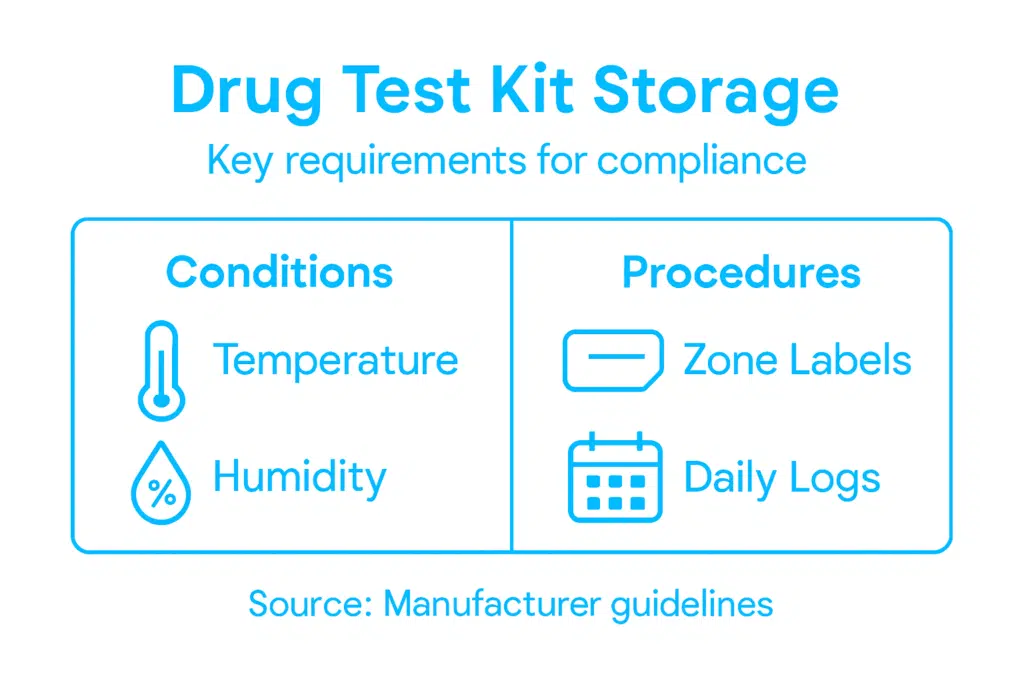
The table below gives a quick reference for optimal storage conditions by drug test kit type:
| Kit Type | Temperature Range | Humidity Range | Special Consideration |
|---|---|---|---|
| Urine Test Cups | 68-77°F | 40-60% | Avoid freezing and excess heat |
| Oral Fluid Test Kits | 68-77°F | 30-60% | Monitor humidity closely |
| Dip Cards/Test Strips | 59-86°F | 15-25% | Store in dry environment |
| Rapid Test Devices | 50-68°F (sometimes) | As specified | May require refrigeration |
Pro tip: Create a laminated reference chart for each storage zone showing the specific kit types stored there, their exact environmental requirements, and acceptable temperature-humidity ranges, posting it visibly so all staff members can verify they’re storing products in appropriate locations.
Manufacturer and Regulatory Storage Guidelines
Manufacturer instructions are not suggestions. They are precise specifications based on rigorous testing that determines exactly what conditions keep your drug test kits effective for their entire shelf life. When you ignore these instructions, you lose any protection they provide. Regulators view this as willful non-compliance. Your organization becomes liable for compromised test results, failed audits, and potential legal consequences. The manufacturer tested every variable in their guidance—temperature ranges, humidity limits, light exposure, storage container type—to ensure the kits perform as advertised. Your job as a procurement officer is to translate those instructions into operational reality at your facility.
Every drug test kit product from Slash Medical and other reputable manufacturers arrives with a product insert or specification sheet detailing exact storage requirements. These documents exist because manufacturers have invested in stability testing protocols that assess how kits degrade under various environmental conditions. This testing follows standardized frameworks established by regulatory agencies and the International Council for Harmonisation. Manufacturers document the temperature ranges where kits remain stable, humidity thresholds beyond which chemical degradation accelerates, and light exposure limits that prevent reagent breakdown. When you receive a shipment, these specifications become your compliance obligations. You cannot store kits in conditions the manufacturer did not explicitly authorize without creating liability and risking test result validity.
Regulatory bodies enforce these manufacturer guidelines through multiple mechanisms. State health departments conducting facility audits request documentation that your storage environment matches product specifications. The FDA inspects distribution channels and final-use sites, reviewing temperature logs, humidity records, and storage area photographs. Accrediting organizations like SAMHSA require written policies demonstrating adherence to manufacturer storage instructions. When auditors find deviations, they document them as compliance violations that can result in suspension of your testing certification. Beyond regulatory pressure, consider the clinical implications. A test result generated from a kit stored outside manufacturer specifications may not hold up in legal proceedings, whether in criminal courts, employment disputes, or treatment program documentation.
Implementing manufacturer guidelines means establishing specific operational procedures:
- Obtain and archive specifications from every product you stock, organizing them by kit type and manufacturer in a centralized reference system accessible to all staff.
- Establish written storage policies that translate manufacturer specifications into facility-wide procedures, including acceptable temperature and humidity ranges with documented upper and lower limits.
- Install monitoring equipment including thermometers and hygrometers calibrated to National Institute of Standards and Technology (NIST) standards, positioned at storage zone locations to capture actual environmental conditions.
- Document all monitoring data with daily or hourly readings depending on your storage environment stability, creating an audit trail that demonstrates continuous compliance.
- Communicate specifications to staff through training sessions and visual signage posted in storage areas, ensuring procurement, warehouse, and clinical staff understand why specific conditions matter.
- Respond to deviations promptly when monitoring equipment detects temperature or humidity excursions outside acceptable ranges, documenting your investigation and corrective actions.
Manufacturer specifications also address shelf life, which is distinct from storage conditions. A kit has a specific expiration date based on stability testing under ideal storage conditions. If your facility cannot maintain those conditions, the shelf life shortens. If a manufacturer states a kit remains stable for 24 months at 68-77 degrees Fahrenheit and 40-60 percent humidity, but your storage environment fluctuates between 50-85 degrees, that kit may only remain viable for 18 months. Your inventory management must account for this reality. Rotating stock becomes critical. Tracking lot numbers and expiration dates prevents using compromised kits that passed storage conditions at some facilities but not at yours.
Regulatory agencies publish their own storage guidance that reinforces manufacturer specifications. State health departments often issue bulletins addressing drug testing in clinics and treatment centers, specifying requirements beyond manufacturer guidance. Some states mandate specific storage temperatures for certain kit types or require quarterly environmental monitoring documentation. Federal agencies overseeing treatment centers publish compliance expectations that reference manufacturer specifications as minimum requirements. Your procurement strategy must account for the most stringent requirements across all applicable regulations, not just manufacturer specifications.
Pro tip: Request stability data directly from manufacturers when their standard specifications seem unclear, asking specifically how storage deviation affects kit validity and documented shelf life, then archive these responses as evidence of your compliance due diligence during future audits.
Environmental Risks and Common Mistakes
Environmental risks to drug test kit storage are not abstract concerns. They are real threats that compromise your inventory, invalidate test results, and expose your organization to regulatory sanctions. Temperature swings, humidity infiltration, light exposure, and contamination happen constantly in most healthcare facilities. They happen in storage rooms without climate control, in utility closets near heating vents, in basement areas where moisture seeps in, and in supply cabinets positioned near windows where sunlight penetrates daily. The mistake procurement officers make is assuming these risks are manageable through occasional monitoring or casual staff awareness. They are not. Systemic mistakes occur because of poor planning, inadequate training, and the absence of rigorous accountability mechanisms.
Temperature excursions represent the most common environmental risk. A storage room maintaining 72 degrees during business hours may drop to 55 degrees at night when heating systems cycle down, or spike to 88 degrees on summer afternoons when air conditioning fails temporarily. These fluctuations cause chemical reactions within test kits that degrade reagent effectiveness. Freezing temperatures are particularly destructive, physically damaging plastic components and causing reagent separation that cannot be reversed. Equally problematic is prolonged heat exposure that accelerates chemical breakdown, reducing shelf life significantly. Environmental risks including temperature extremes can render kits unreliable long before their printed expiration dates. Yet many facilities store test kits in spaces with no temperature monitoring whatsoever, discovering the problem only after kits have been damaged. The staff member responsible for storage may not even realize conditions were unsuitable until a quality control check reveals invalid test results.
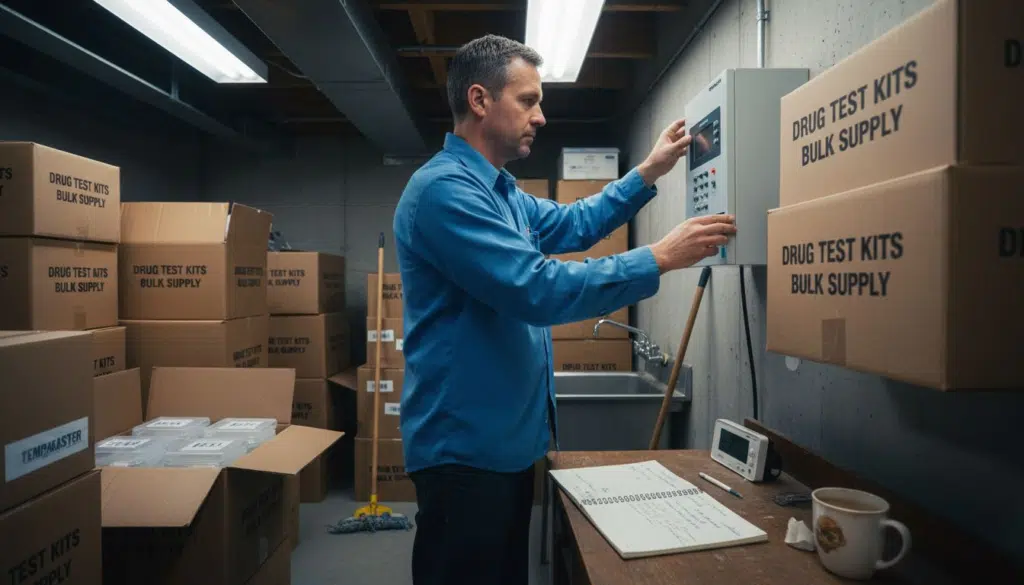
Humidity control represents a second critical but frequently overlooked area. Test kits stored in high-humidity environments absorb moisture that corrodes reagent coatings and destroys the chemical precision required for accurate testing. Conversely, extremely dry conditions can cause reagents to crack or separate from their substrates. Basement storage areas are notorious humidity problems, with moisture levels fluctuating wildly based on weather conditions and groundwater activity. Storage areas adjacent to bathrooms create humidity challenges from ventilation systems and personnel activity. The mistake most facilities make is storing test kits wherever space is available rather than evaluating humidity characteristics of potential storage locations. By the time auditors point out the problem, inventory worth thousands of dollars may already be compromised.
Light exposure accelerates reagent degradation through photochemical reactions that destabilize active compounds. Direct sunlight creates temperature increases plus UV exposure simultaneously, a double assault on kit stability. Storage areas near windows, even windows covered with standard glass, expose kits to significant light damage over time. Fluorescent lighting in storage areas, while less harmful than sunlight, still contributes to gradual degradation. Many facilities address this mistake by simply moving kits to darker areas or using opaque storage containers. Yet initial damage may have already occurred if kits were stored improperly during receiving and temporary staging.
Common storage mistakes cluster around three operational failures:
- Lack of written policies means staff members make independent decisions about where to store kits based on convenience rather than environmental suitability, creating inconsistent storage conditions across your facility.
- Insufficient staff training results in personnel unaware of storage requirements, unfamiliar with equipment like thermometers and hygrometers, and unable to recognize environmental problems or respond appropriately when deviations occur.
- Absence of monitoring systems prevents early detection of environmental excursions, meaning problems persist for extended periods before discovery, compromising entire inventory batches.
Additional mistakes include storing incompatible materials adjacent to test kits. Some disinfectants, cleaning supplies, and medications emit vapors that contaminate test kits or interfere with reagent chemistry. Improper inventory rotation causes old kits to expire before newer stock, wasting money and forcing purchasing of replacement products. Cross-contamination from dust, pests, or poorly sealed containers introduces foreign materials into kit packaging, compromising sterility and test validity. Inadequate drug storage practices frequently stem from organizational pressure to minimize storage space costs, causing facilities to overcrowd storage areas and prevent adequate airflow and monitoring access.
The correction process requires confronting uncomfortable truths about your current operation. Evaluate your existing storage areas objectively. Are they climate controlled? Do they maintain consistent temperature and humidity? Are they protected from direct light? Do they store only test kits and compatible materials, or has mission creep converted them into general supply closets? Are staff members trained on storage requirements? Do monitoring systems exist and function reliably? Are environmental records maintained and reviewed? If you answered no to any of these questions, you have identified compliance vulnerabilities requiring immediate attention.
Pro tip: Conduct a baseline environmental assessment of your current storage areas using temporary data loggers that record temperature and humidity for two weeks, then compare actual conditions to manufacturer specifications to quantify how severely your storage environment deviates from requirements.
Best Practices for Secure Storage Procedures
Secure storage procedures transform storage from an afterthought into a controlled system where every variable is documented, every risk is mitigated, and every staff member understands their role. Best practices go beyond simply maintaining acceptable temperature and humidity. They establish accountability frameworks that create audit trails, prevent unauthorized access, enforce inventory discipline, and enable rapid response when environmental conditions deviate from acceptable ranges. When procurement officers implement these procedures systematically, they eliminate the guesswork that creates compliance vulnerability. The result is a storage operation where test kit integrity is preserved, regulatory expectations are consistently met, and staff members confidently know they are protecting product quality.
Physical security of storage areas forms the foundation of secure procedures. Drug test kits should be stored in controlled access areas that limit entry to authorized personnel only. This prevents unauthorized removal of inventory, reduces cross-contamination risk from untrained staff members, and ensures accountability for kit handling. Access controls might include locked storage cabinets, secure rooms accessible only to designated personnel, or cabinet systems with sign-in logs documenting who accessed inventory and when. Beyond preventing theft, controlled access prevents casual staff members from retrieving kits from inappropriate locations or storing items in unsuitable conditions. Many facilities discover kits stored in break rooms, patient waiting areas, or supply closets accessed by dozens of people daily. Controlled access eliminates this problem by designating specific storage zones exclusively for test kit inventory.
Environmental monitoring with calibrated equipment transforms assumptions about storage conditions into documented evidence. Install calibrated thermometers and hygrometers at multiple locations within storage areas, positioned where they accurately reflect conditions where kits are stored. Record readings at consistent intervals, whether daily, twice daily, or hourly depending on your storage environment stability. Use NIST-traceable equipment that can withstand audit scrutiny. Digital data loggers that automatically record readings provide stronger documentation than manual logs vulnerable to human error or gaps in coverage. When you detect environmental excursions beyond acceptable ranges, document your investigation and corrective response. Did the heating system malfunction? Did someone leave a door open? Did a water pipe leak creating humidity spikes? Detailed investigation records demonstrate to regulators that you respond proactively to deviations rather than ignoring problems. These records also identify systemic facility issues requiring capital improvements, such as inadequate HVAC systems or aging infrastructure.
Inventory management protocols prevent waste and ensure older stock rotates out before newer inventory. Implement FIFO rotation (first in, first out) so kits purchased earliest are dispensed first, preventing expiration of aged inventory while newer stock sits untouched. Track lot numbers and expiration dates in your inventory system. Conduct physical counts at regular intervals, comparing actual inventory to system records to identify discrepancies immediately. Segregate expired or damaged kits from active inventory, ensuring they cannot be accidentally dispensed. Destroy compromised kits according to your organization’s protocols, whether incineration, decontamination, or return to manufacturers. Many procurement officers discover expensive inventory losses because they lacked visibility into what was stored where and when items expired. Systematic tracking prevents these losses.
Staff training ensures that storage procedures are understood and followed consistently across your organization. Best practices for secure storage require that personnel understand why storage conditions matter, how to recognize environmental problems, and what to do when deviations occur. Train all staff members with storage responsibilities including receiving personnel, warehouse workers, clinical staff, and supervisors. Cover topics including acceptable temperature and humidity ranges, light protection requirements, proper handling of kits, inventory rotation procedures, and documentation expectations. Provide refresher training annually and whenever procedures change. Document training completion to demonstrate compliance during audits.
Key components of best practice procedures include:
- Written storage policies documenting acceptable conditions, monitoring requirements, equipment specifications, staff responsibilities, and deviation response protocols.
- Environmental monitoring using calibrated equipment positioned strategically throughout storage areas, with readings recorded at consistent intervals and maintained as permanent records.
- Inventory accountability through tracking systems that record lot numbers, expiration dates, quantities, and storage locations, with regular physical counts comparing actual to documented inventory.
- Access controls limiting storage area entry to authorized personnel, with logs documenting who accessed inventory and when.
- Deviation response procedures specifying how to investigate and document temperature or humidity excursions, including immediate corrective actions and escalation to management.
- Equipment maintenance ensuring thermometers, hygrometers, and climate control systems are calibrated, inspected, and repaired regularly to maintain functionality.
- Documentation retention maintaining all environmental records, inventory logs, training records, and deviation reports for the periods specified by your regulatory framework, typically several years.
Implementing controlled access and documented accountability transforms storage from a compliance burden into a system where every stakeholder understands their role. When a procurement officer asks a warehouse worker why kits are stored in a particular location, the answer should reference specific manufacturer requirements and facility policies, not casual convenience. When a clinical director audits storage areas, they should find documentation supporting every observation. When regulators inspect your facility, they should encounter evidence of systematic, deliberate storage management rather than ad hoc practices.
Here’s a summary of how secure storage best practices impact your drug testing program:
| Best Practice | Benefit | Business Impact |
|---|---|---|
| Written Policies | Ensures consistent compliance | Reduces risk of audit failure |
| Environmental Monitoring | Detects condition deviations quickly | Prevents inventory loss |
| Staff Training | Promotes correct daily procedures | Enhances test kit reliability |
| Inventory Tracking | Reduces expired kit usage | Saves money and avoids errors |
Pro tip: Create a simple one-page reference card for each storage zone showing acceptable temperature and humidity ranges, required monitoring frequency, and steps to take when conditions deviate, then laminate and post it visibly so staff members can verify compliance without consulting lengthy policy documents.
Secure Your Drug Test Kits with Confidence and Compliance
Ensuring proper storage conditions for your drug test kits is essential to maintain accuracy and meet regulatory requirements. The challenges of controlling temperature, humidity, and light exposure can put your inventory and patient trust at risk. Avoid costly mistakes by partnering with a reliable supplier who understands the critical nature of these needs and offers FDA-approved, CLIA-waived drug test kits designed for forensic and clinical use.
At Slash Medical, we specialize in providing wholesale drug testing supplies including urine cups, oral fluid test kits, dip cards, and test strips that meet strict manufacturer and regulatory storage guidelines. Our extensive product catalog ensures you can source the exact kits your facility requires in bulk with competitive pricing. Benefit from our private label and OEM services as well as nationwide shipping to streamline your procurement and inventory management processes.
Make protecting your testing program easier by choosing a trusted partner who supports your compliance goals every step of the way.
Ready to safeguard your drug test kit inventory while optimizing costs and reliability?
Explore our full range of high-quality drug test kits at Slash Medical and discover how easy it is to order bulk supplies built for secure storage and regulatory compliance. Start ensuring valid, dependable results today for your clinic or treatment center by visiting Secure Drug Test Kits now.
Frequently Asked Questions
What are the optimal storage conditions for urine drug test cups?
Urine drug test cups typically require a storage temperature between 68-77 degrees Fahrenheit (20-25 degrees Celsius) and humidity levels of 40-60%. Avoid freezing and excessive heat to maintain their effectiveness.
How can I ensure that my drug test kits are stored properly to avoid false test results?
To avoid false test results, store drug test kits in a controlled environment that adheres to manufacturer specifications. This includes monitoring temperature and humidity, protecting kits from light exposure, and keeping them in dedicated storage spaces.
What common environmental risks can compromise drug test kit integrity?
Common environmental risks include temperature fluctuations, high humidity, light exposure, and contamination. These factors can degrade the chemical integrity of test kits, resulting in inaccurate test results and compliance issues.
Why is it important to follow manufacturer storage guidelines for drug test kits?
Following manufacturer storage guidelines is crucial to ensure the stability and reliability of drug test kits. Ignoring these guidelines can lead to compromised test results, regulatory non-compliance, and potential legal liabilities.